Should allies use they/them pronouns?

For every opinion a trans person shares, you can always find someone who disagrees. It may surprise you but we don’t have annual meetings or anything to decide what our unified message is. But one thing that concerns me and I suspect didn’t originate in the trans community is the idea that cisgender “allies” should adopt they/them pronouns for themselves.

And I’m going to go ahead and say that’s a big old NOPE from me. I want people around me who proudly own their pronouns in a way that normalizes the asking and sharing of them. We need to model to people who are still learning that pronouns are not something that should just be assumed based on appearance. If you don’t know how someone wants to be referred to, the safest option is something gender neutral. But the best practice is always to ask first and get used to doing it so that it doesn’t feel uncomfortable anymore.

And don’t walk into a conversation, especially where trans people are present, and say “oh, I don’t care what pronouns you use for me” if you are cisgender. All that signals to us is that you are so confident that you will be gendered correctly that you are willing to accept people’s assumption. It’s a sign of your privilege and based on the reality that you have never had the deep discomfort that comes with being constantly misgendered everywhere you go. Now of course there are plenty of nonbinary people who for various reasons are apathetic about their pronouns or don’t feel comfortable setting expectations. But we don’t need you muddying the waters.

Nonbinary people are constantly fighting this idea that our identities are a “fad” or a phase to not be taken seriously. Our enemies are actively looking for reasons to dismiss us and prove that this is just some social justice plot to make people uncomfortable. And when those people see you lightly using these pronouns, especially if you only do so to “teach them a lesson” or in liberal circles, they take us less seriously too.

So please, leave they/them pronouns for nonbinary people and for people whose gender you don’t know. Own your pronouns boldly by doing things like putting them in your email signatures, on your nametags, or wearing pins at events. Make it clear to people around you that the only way to know pronouns is if someone has told you. And model that by telling them what you actually use.

And remember, be kind about how you correct people. Gendered language has been hard wired in our education and systems for long enough now that there are a lot of people who have unlearning to do. And many of those people have less access to learn about how and why to do that. In particular, when you are interacting with working class folks such as service staff or people for whom English is their second language, have some patience. It may take many times of correcting people but believe me when I say that a gentle hand with a carrot is going to make a far bigger difference than a slap on the wrist.

When you see someone being misgendered around you who has already made their pronouns known in that space, please speak up and say something. Correct that manager who intentionally or unintentionally misgenders their staff member in a meeting. The good managers will show you who they are by responding in kind and the bad ones will then be forced to make a choice about whether to keep persisting intentionally. And if you see it happen to someone you know and you aren’t sure if you should say something, ask them privately afterwards. Sometimes it’s easier not to make waves or they may not be out in that situation. But often times it is just because we are exhausted of constantly correcting people every moment of our lives. Our patience has worn thin because of the constant mosquito bites of microaggressions but you as an ally have the ability to advocate for us without as great of a power differential.

If you see it happening repeatedly from the same people, maybe offer to have a practice session with them where they talk about the things they appreciate about the person they misgendered to you in a safer space where they feel less embarrassed being corrected. There are a lot of steps that you as an ally have the ability and power to do to normalize the use of gender neutral pronouns. Just don’t appropriate them yourself.

And finally, remember that Allyship is a verb. It’s not some badge you earn because you are vaguely supportive. You have to do that work actively.
Inheriting a fixer-upper

I just scheduled my jaw surgery to do the first part of correcting my bite for mid-May. It’s something I’ve been dreading for the last 10 years since my dentist identified the root problem. And I’ve been surprised at how many emotions around surgery are coming up for me now that it is an undeniable reality, not just about this procedure but about my plans for bottom surgery.

My original plan was to get my jaw surgery out of the way this year and then go in for vaginoplasty next year. And in the interim I was going to meet with the surgeons I was interested in when they were in town for Gender Odyssey. But now I feel like that plan has come crashing down around my ears (like most plans have in my life).

I found out a few weeks ago that my jaw surgery is so intensive that they need to split it into two separate procedures with a year of expanding my top palate in between. So now I have another surgery on my face to dread but at least I have jaw feminization included to look forward to. Unfortunately that means I have to rethink my whole plan around bottom surgery.

To complicate things further, I found out that Gender Odyssey isn’t in Seattle this year and they aren’t doing a conference for trans adults this year anyway. So now there’s no opportunity to meet with them that doesn’t involve investing in travel. I feel like I need to decide whether to try to attend Philly Trans Wellness where I might meet some potential providers (although not my top choice – Heidi Wittenberg), or whether to travel to San Francisco to meet with them directly.

And trying to figure this all out while I’m also undergoing intensive laser hair reduction on my face (I put electrolysis on hold for now because it was too slow) just feels like so much. I feel totally overwhelmed by how far I still have to go before I’m done with all these medical procedures and honestly I’m feeling pretty despondent and hopeless about it all.

I just want to fast forward to a point in time where I feel like my body is my own. But instead I feel like I inherited a fixer-upper house that needs major repairs to be livable and every time I fix one thing, another breaks. I know that all these surgeries and procedures aren’t going to fix everything but I still have to rest my hopes on life getting easier once I’m past it all. Because without that hope I don’t know how to keep going.

This is one of those points where I really wish I had been born with a brain and body that matched and I didn’t have to go through all this work just to be myself. And sometimes it feels like I should just throw in the towel on life and give up. Don’t worry, I don’t actually have plans to do so but I can’t say I haven’t thought about it.

Anyway, I don’t know where all this is going right now other than hopefully forward even if it takes a painstakingly long time to get there. I know I wouldn’t be able to keep wading into the fray if it wasn’t for my partners and friends so I am very thankful to all of them for keeping me going. I know things have to get worse before they get better but I really hope I turn that corner soon.

On losing friends

Something I talk about less, mostly because it’s hard to dwell on, is how many friends I’ve lost over the years. So many former friends have either actively or passively rejected me over the years because of various turning points in my life and a lot of it ties back to gender.

I grew up in a very conservative household and for all of my childhood, that was my only circle of friends. Being homeschooled I didn’t have much opportunity to meet people who weren’t like me. My entire social sphere were also Evangelical Christian and very socially conservative themselves. So when I started to become more liberal in my politics and thoughts in college, particularly around supporting sexuality, I lost most of my childhood friends, even my best friend and the only cis man I was really ever close to.

Of course since I am a very extroverted person, I made a lot of new friends in college, particularly in the first couple years. But many of those people were also Evangelical Christians because of where I went to school and who I was when I started. So many of them slowly drifted away as I went further left in my thinking or because of my relationship to my very toxic ex spouse who I met in college.

The third round of loss happened when I decided to get divorced because of the emotional abuse and incompatibility with my ex wife. Many of our friends at that point either took her side because of the lies she told or didn’t know how to respond (because women can’t be abusers, right?). I also lost most of my communities during that time because I could no longer go to the same church or spaces for fear of running into her.

To be quite honest, if I hadn’t already started building polyamorous community and met my now spouse before that time, I’m not sure I would have survived. I had been deeply depressed for a long time and I felt very betrayed and isolated. And because of how my ex treated me and controlled our money, I had no savings and no self worth. The final straw in that marriage was me starting to awaken to my queerness and gender and she wanted me to remain closeted for her convenience because she was ashamed of her own asexuality.

But I rebuilt and kept going. Partly because I am an obligate extrovert and I had no other choice. My new partner’s friends and chosen family took me in and were so supportive during that time and they are still my closest friends. During that time I also started building new romantic relationships with my partner as we dated together.

Unfortunately a couple years ago in what we now call “the summer of hell,” I lost a major relationship of 2 and a half years. The person I had been dating decided that instead of breaking up with me cleanly, they would say they wanted to be friends but then behind my back spread rumors and distance themselves emotionally. And when I brought it up, they tried to blame me for that distance. Unfortunately we had intertwined our communities and polyamorous households so much at that point that I felt like I lost half of my family when they betrayed me. And even over a year later, I feel that loss of community very deeply.

But again I threw myself back into relationship building. I joined a trans community group on the path to becoming a nonprofit on their board. I invested a lot of time and energy into trying to create the type of community I wanted to see. Then a fellow board member turned on me and very aggressively painted an inaccurate picture of me that cause many other community members to take their side. They set me up in a way that I couldn’t defend myself without seeming like the aggressor myself. And while there were many people who showed private support during that time, public opinion was so soured that I couldn’t see myself ever trusting that space again. And so I lost more friends and another important community space.

I’m still working on rebuilding from all those losses. And I haven’t given up. But it is hard to trust people when you have been betrayed and abandoned so many times. The thing about trying to live authentically is that you make a lot of enemies along the way. When your sexuality and gender are so politicized that living openly is guaranteed to piss some people off, you lose people. And that constant tension breeds emotional vulnerability that also plays out in inter-community trauma.

I’m still working through my fear and trust issues related to all of this so I can’t say that I have reached the other side yet. But I am extremely grateful for my spouse and the chosen family I have built that have stuck by me and supported me through all of this. I mourn the lack of community but yet I still have a deep desire to build a space where trans people can support each other without the fear of attack from within or without. I don’t know how to do that yet but I dream and I take the steps forward whenever I find them.

Queer hair

I finally got a haircut this weekend and I feel so free and like myself again!

Haircut

I spent a lot of time the last couple weeks leading up to my haircut agonizing over what to do. It turns out I have a lot of feelings wrapped up in my hair and I have a hard time balancing my needs.

I’ve been trying to grow out my hair, at least on one side, because I want to be more obviously feminine and hopefully get misgendered less often (or at least as “she” not “he”). But I’m not sure how much of that is just to meet perception and societal expectations and how much I actually want long hair. Because every time I grow it out I feel miserable. Mostly because my hair gets in my face all the time and that annoys me more than just about anything. I have a lot of social anxiety / nervous ticks around keeping my hair neat and tidy which turns out doesn’t mix well with long curly hair.

I’m not sure if I’ve completely given up on that but I did need a solution that kept my hair more out of my eyes. I also want my hair to signal my queerness which I think is an even higher priority for me. And one way to do that is with asymmetry and shaving the side of my head.

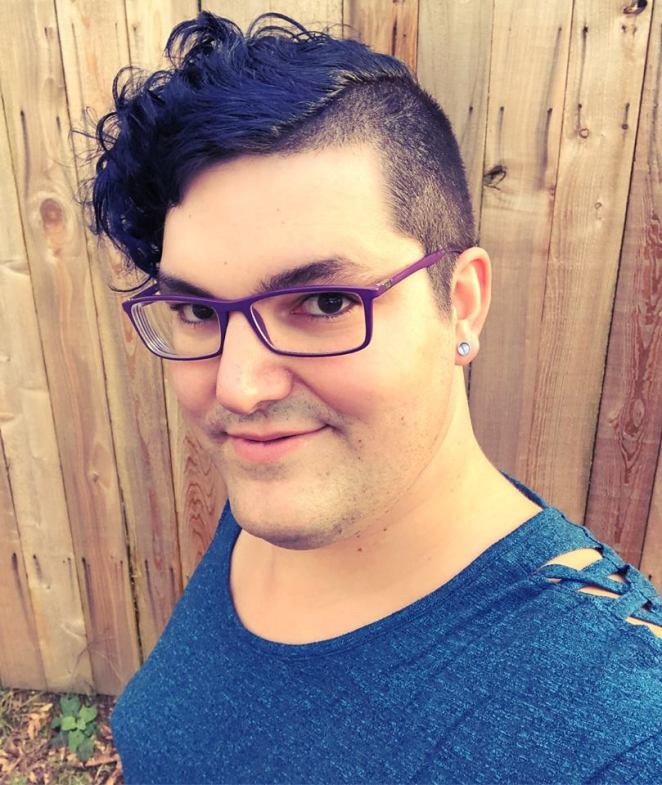
I’ve been doing the shaved side pretty much since I came out 4 years ago but it had been getting long in my attempt to grow it out. I used to shave both sides and the back of my head to just have it longer on top. But this time I decided to do a higher uppercut to eliminate some of the part on the front and top that falls in my eyes and leave the back curly. I also bleached and dyed my hair purple again yesterday.

I really like how it turned out and I feel very feminine and very aggressively queer which is my goal. It’s amazing how much my emotional state relates to the state of my hair. And I’m very thankful for a great stylist who knows me well and gets what I’m saying when I come to her with a problem.

I’m published!

I’m a published author! I am so honored to be included in a book with so many icons of gender diversity. Check out my chapter on “Hypervisibility” on page 58 of “Nonbinary: Memoirs of Gender and Identity.” Preorder yours now at www.amazon.com/dp/0231185332 or direct from the publisher at https://cup.columbia.edu/book/nonbinary/9780231185332 to receive your copy on April 9th.

n-dimensional hypergender

One aspect of myself that I’ve talked about less here is that I’m trained as an ecologist. And one of the coolest concepts that I learned in my ecology degree program was how ecological niches can be visualized as an n-dimensional hypervolume.

Now that’s a lot of sciency jargon there but I’ll break it down for you. In ecology, one of the most important features of an animal is how it matches up to a specific set of environmental conditions and resources it needs to find it’s unique place in the ecosystem that doesn’t completely compete with another species. And the number of factors involved are so numerous that they are theoretically infinite. Which means that you can’t really map out niches on a 2 dimensional or even 3 dimensional drawing. You need a near infinite number of dimensions (n here mathematically representing the number of dimensions) to accurately portray it.

Here’s a visual representation of an n-dimensional hypervolume (source)

The reason I bring it up is because this is how I think of gender. To a cis person, gender might seem like a simple, 2 dimensional concept. For most people who haven’t really thought about it, there are only 2 main categories and if you’re lucky, some basic variation within them. There might be some outliers or people that switch boxes but overall pretty basic.

Well for most of the queer and trans people I know, especially nonbinary folks, gender is a multifaceted abstract concept. Depending on the person you talk to, it can be static, fluid, a void, or something else entirely. But I don’t know a whole lot of nonbinary people who really describe it in a form you could easily represent in a 2 dimensional drawing. Now maybe 3 dimensions is enough but I think that when you look at all the different sets of expectations, behaviors, ways of thinking, ways of being, feelings, attitudes, context in which you are deciding, etc, that you have a hypervolume. Or in this case, a hypergender.

I’m sure that I’m not the first person to conceptualize it this way. Some quick searching shows that Asmaa Guedira wrote a bit about this idea starting in 2016. But I wanted to share my nerdery about how my concepts of ecology and gender have overlapped. Because even though I don’t work in ecology (thanks recession), the concepts I learned there have helped me synthesize knowledge by looking at a bigger picture.

There is so much diversity of gender out there in the world. Just here in Seattle I know people who are agender or gendervoid and don’t feel any strong sense of gender. I know folks who are genderfluid and switch presentation and pronouns depending on the day or mood or context. I know people who solidly feel like they are a third gender halfway between male and female. There are people who are demigender where they partially identify with a particular gender and partially not. And then there are of course hundreds of other concepts from cultures around the world, some of which have been around for thousands of years.

One of the foundational concepts that you learn in ecology is that diversity begets stability. The more species you have in more niches interacting with each other, the more stable, resilient, and resistant to extreme disturbances the ecosystem is going to be. In other words, we need all this diversity because it makes humanity greater as a whole. If you only have one or even two genders, races, cultures, etc at the table, you are missing huge chunks of human experience that are probably relevant to whatever you are discussing or deciding.

I hear a lot of people saying that “we don’t need labels” or that we are trying to create a world without gender. Which is exactly the opposite of what I’m trying to do. I want to build a world with an infinite number of genders co-existing in an ecosystem of human experience. It can feel at times like having so many labels makes gender irrelevant or meaningless but for many of us, having words that we can put to our experience is so empowering and freeing. Especially in the modern age of the internet, it gives us the ability to find people like us and the language to share what this important part of life feels like.

Why you need to reject the idea of “passing” as cis

As I’m reading through some of the older articles by one of my favorite authors, Kai Cheng Thom, I came across this beauty:

How to Love Being a Non-Passing Trans Woman in 9 Affirming Steps

And I’m reminded how crucial accepting that fact was to my coming out journey.

There is so much pressure, both in the cisnormative world around us and from other trans people, to achieve some level of “passing” where people on the street or sometimes even people in the sheets can’t tell you are trans. For so many trans people, their ultimate goal is to get to a point where people think they are cisgender. And while there is a lot of power and safety in that and I absolutely do not blame people for wanting that, it is also a dangerous trap that can hold us back from truly being happy.

For so much of my life I thought that I couldn’t be trans because my body had grown in ways that I knew I could never reverse. With my broad shoulders, my strong chin, my large hands, my massive feet, and my deep bass singing voice, I knew that no matter how much surgery I had, I could never achieve my ideal of how I thought a woman should look. And I thought that meant that womanhood itself was hopelessly out of reach and at best I could just be a feminine man who was too attracted to women to be gay but too abnormal to be loveable. And it was largely because of that false belief that I allowed myself to settle for an abusive marriage.

For me at least, the path to self acceptance lay in embracing my femme identity with the full knowledge that I will never pass. I had to grieve the body I would never have and love the body I did have. I started out looking for the people who looked like I could when I started. Nonbinary icons who have never done medical transition and proudly display their beards and stubble like Alok Vaid Menon, Jacob Tobia, and Jeffrey Marsh. I surrounded myself with trans women so gorgeous that they take my breath away and I’ve slowly come to realize that I am that person for other people too. I leaned into the aspects of myself that I could make feminine for myself even if other people gendered them differently. I found joy in finding clothing that emphasized my tall frame and those rare gems that were size 13 heels.

I had to reject consciously and daily the idea that had to look traditionally feminine to be femme. Because femme at its core is a queer identity based in simultaneously embracing and queering feminine traits while rejecting many of the oppressive gender norms. My partners who are fiercely fat and femme helped me learn through this process how to hold yourself boldly even when you get glares in public for doing so. Of course I am not confident every day or even most of the time, but putting on that armor of femme identity helps push through those moments. I am femme despite society, not because of it. And finding my corner of weirdos and unconventional beauty helps me see the beauty in myself.

Once I had laid the groundwork in embracing my body and finding the parts of it that I love, only then could I truly identify what areas of my body needed change to fit MY dysphorias rather than what other people were projecting onto me. In many ways I truly loved my beard and how dramatic it made my face when paired with makeup and a dress. But I also could see how much happier I could be if I stopped avoiding my chin and made the necessary changes to bring it in line with who I want to be. And sometimes that means that things will get worse before they get better. But it is a lot easier to bear when I am doing these things for myself and not because I think I have to.

Another thing that has helped tremendously is realizing the incredible variety that exists within gender. For me, I like to look up to the cisgender women in my life like my mom who is 6 foot and my aunt who is 6’2″ and wears the same size shoes as me. And yes, sometimes they get accosted in restrooms about whether they belong but because they clearly do, it helps me know that I can too (not that I’ve actually worked up the courage for that yet). Women literally come in all shapes and sizes so don’t let someone tell you that you aren’t fully a woman because you look a certain way. They can shove off with their internalized misogyny.

Do I walk through the world confidently every day? Absolutely not. Do I love every aspect of my body? Hell no. Do I question the path I’ve taken? Sometimes. But I have earned my femininity just as much as someone who fits whatever this decade’s ideal of female beauty is. I am a nonbinary woman and I don’t need to pass.

The power of support

Have I mentioned recently how amazing my chosen family is? I am incredibly lucky to find myself at this point in my life surrounded by the queerest, most supportive friends and partners imaginable. And I want to take a moment to acknowledge how much that support means to me and keeps me going.

Do you know how wonderful it is to come home every day to a house full of amazing queer and trans humans who have chosen to make me a part of their lives? I live with my spouse and anchor partner of 4 years, a bold, proudly fat and femme, queer cis woman who supports me in all the little ways that matter so much. I never feel like an oddity or burden when I’m around her because she has shown repeatedly that she can handle the hard stuff, saying the right things to reassure me when my brain is being mean and holding me close when I’m depressed. Not to mention providing fashion inspiration!

My household also includes my spouses partner, my metamour, a sweet Southern transmasculine person who joined us last year, as well as an amazing queer woman who defies categorization filling simultaneously best friend, romantic-turned-platonic partner, and close chosen family places in my heart. Life isn’t always easy when you live in a house with a bunch of queers with anxiety disorders but we hold each other up and support each other both emotionally and financially by sharing expenses based on how much we make relative to each other. Sharing a house together holds so many perks, especially knowing that when you have a hard day there will be someone to talk to and hold close.

Then there’s my chosen family and friends who cheer each other along as we stride through this world that isn’t always so friendly for us. I have so many queer and trans friends, and a few token cishet ones, who show up for the hard work. When I’m down I know that support is only a message away and that helps a lot. And being polyamorous, there’s plenty of people that blur the lines too. My life is full of former partners, either of mine or my spouses, and budding new relationships with other nonbinary folks. The best part is that I’m never lacking in cuddles!

I’ve talked a lot here about some of the hard parts of growing up in a conservative religious family but for all that my parents have been far more supportive than I could have imagined. Despite some incredibly vast ideological differences, they have stuck around and showed me that they do love me even when they don’t understand me. They live close enough that I get to see them at least once a month and they have opened up their hearts and home to all my partners and friends as well. They still struggle with pronouns but are slowly getting better and have grown so much in the past dozen years.

I am so sad that every person doesn’t have the kind of love and support in their life that I have found but I want to offer some proof that you can find that even if things seem bleak at the time. I went through some very isolating years in my previous marriage where even when I had friends, there were very few I could truly be honest with. I’m really lucky that my best friend from college survived all my ex’s attempts to sabotage our attempts to stick together. I’ve lost almost all my friends several times now but seeing who sticks around when it’s hard does help you find your true friends.

I know it sounds cliche but the point is that you need to keep trying. It does get better. And it’s because of all the support that I have gotten as far as I have in my transition.

What is dysphoria?

So I’ve talked quite a bit here about my experiences with dysphoria but I’m not sure I’ve ever attempted to define it, partly because it is a tricky concept to convey to someone who has never experienced it. But I’ll take a stab at it with the disclaimer that trans people don’t all experience dysphoria in the same way and some trans people never experience it because contrary to what psychologists think, being trans doesn’t require dysphoria. Some people are lucky enough to discover their true self through the experience of gender euphoria which is when you have extreme joy in finding something about your body, presentation, or the way people perceive you that affirms your gender.

On most days, I have a low level of background dysphoria going on. Some of it has always been there and I was kinda successfully ignoring it and some of it may not have been and has developed or been revealed as I’ve gotten closer to bring other parts in alignment with my gender. It’s hard to look back and accurately know what I was thinking in the past because one of my experiences of gender dysphoria is that my brain blocks out a lot of memories that don’t align with who I really am. A lot of my past is fuzzy or completely blocked from my consciousness due to trauma as well.

What I do know is that there were times that do clearly stick in my head where I experienced bursts of gender euphoria as a kid such as when I would play dress up and walk around in heels, or when I would play imaginary fairies or mermaids with my sister, or when I felt accepted as “one of the girls” in my friend groups. A lot of that went away as I reached an age where gender roles were more strictly enforced and in particular, a lot of my puberty is blocked from my memory both due to how I was treated by society and because more of my dysphoria started becoming apparent as the wrong hormone was taking front seat. I am so jealous of kids who have affirming parents and figure it out early enough to use hormone blockers or transition early on before the wrong puberty goes too far. It makes a lot of things easier.

One of the things I do know is that early on, stubble gave me dysphoria similar to how it does now. That, and my dysphoria around my prominent chin, are the biggest reasons I grew a beard at 18. I was getting to the point that I would have to shave my chin twice a day to look clean shaven. At first it was just a goatee but by 21 I think I was able to grow a full beard. A positive for combating dysphoria at the time but unfortunately now I have to get rid of all that thick, dense hair very painfully.

On a daily basis, dysphoria is like having little pin pricks constantly poking your skin. Or like wearing shoes that are too tight. It’s annoying and eventually it brings you to a breaking point. Everyone’s tolerance of that breaking point is why some people don’t come out until later while others figure it out early on. That can also be helped along by someone effectively helping you find the right size shoe and suddenly you realize how they didn’t fit all along. And trying to push past that background pain every day is exhausting and means that you can’t bring your full self to what you are doing until it is dealt with. I sometimes wonder where I would be in life if I had been born cis and been able to just move along happily through life without having to stop and deal with the dysphoria or the self worth issues that go along with it.

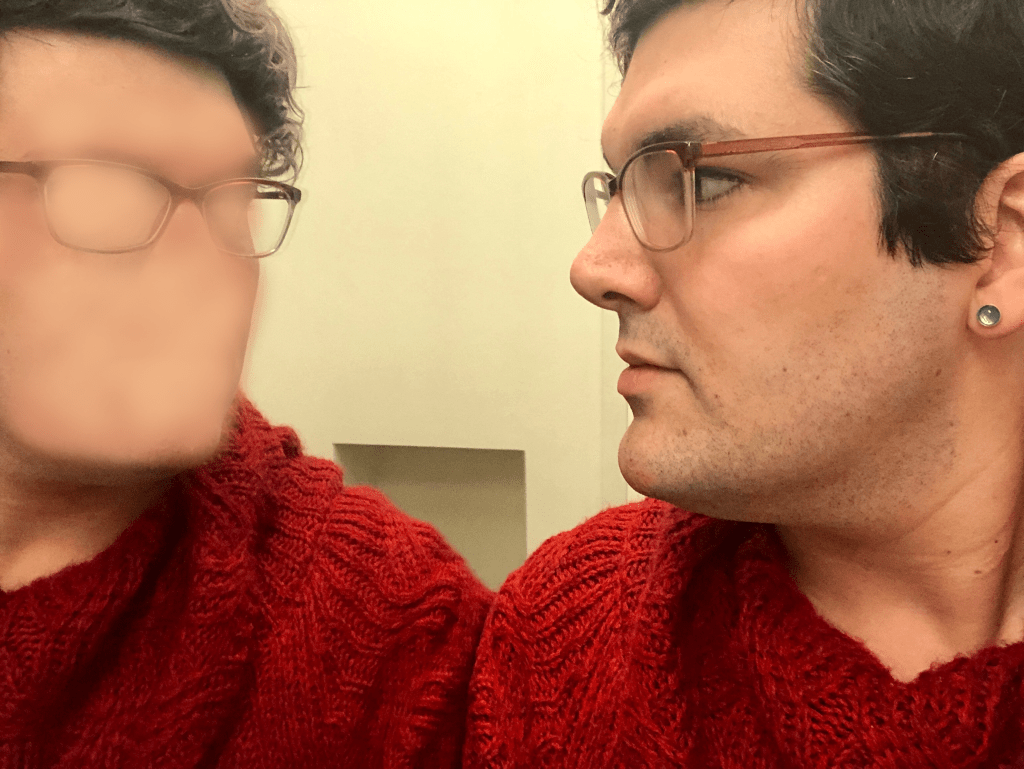
On days when my dysphoria is more acute, that pain is brought more to the forefront of my mind. Sometimes it is bad enough that I will look into a mirror and I can see enough to style my hair or assess my outfit but my face will be completely blurred out – as in I physically cannot get my brain to see my facial features. Dysphoria, as far as I can tell, is the brain not being able to handle the cognitive dissonance between the reality of your brain’s self image of you and what is physically in front of you. It also means that even on less bad days, parts of my body are often distorted so that what other people see isn’t the same as what I see. For me that most often revolves around my chin, or shoulders, or body hair. I will look at myself and all I can see is what feels to me like a giant, cartoonishly distorted chin with a cleft so big that I feel like Gaston from Beauty and the Beast.

Another way that dysphoria plays out for me, especially lately, is that an area of my body may feel completely absent. Most days now my genital area essentially feels like a black hole. It doesn’t exactly feel like there’s nothing there but almost the opposite of nothing like antimatter or something. That’s probably the biggest reason I’ve been much more asexual lately, at least with my own body. It is hard to think about sex when your mind is actively avoiding thinking about what body parts you might use. I’ve had to be much more creative and luckily when you have queer partners, using your own genitals isn’t as essential.

I’ve found that what helps the most when I’m feeling actively dysphoric is to focus on the parts of my body that I do like. Often it doesn’t help to have people compliment the areas you are feeling dysphoria around because it just brings more attention to them. But focusing on things like how great my legs are or how soft my skin is gets my mind to see the positives and less of the negatives. Sometimes affirmations can be helpful though, even if in the moment you can’t hear them. Lately I’ve been feeling more dysphoric around my speaking voice but when I’ve told people that, many have told me that it isn’t particularly deep and is actually rather feminine. Those are the things that I come back to later and think about when I’m struggling.

The reason that it is so essential to have insurance that covers gender affirming treatments and low barriers to accessing them is because dysphoria is such an insidious beast. It often feels like you can’t be a whole human until these parts of yourself are aligned with who you really are. And ultimately, all most of us really want is to be fully seen as ourselves. So please, don’t put up barriers to keep trans folks from getting there.

PS – I just remembered another trick I found to help combat dysphoria. Find things that you can do with your body to make it feel like your own that you can focus on when the rest of it feels wrong. For me it really helped me to be able to see myself to get my ears pierced, get fun glasses, get visible tattoos, and dye my hair. These things remind me that I can make changes because it is my body and my rules.

Metamorphosis

I’ve heard many trans people use the allegory of metamorphosis and seeing their transition phase as a cocoon but it really feels true. I am still struggling to figure out who I am without my beard now. The beard was a big part of who I was as a caterpillar and now that I don’t have it I am struggling to see the butterfly underneath the stubble. I can see my wings starting to form and I’m looking more and more like the idealized version of myself every day. But right now, especially between braces and electrolysis, I very much feel like I am in a cocoon phase. I really wish that I could just hide away until my metamorphosis is complete. But sadly I need a job and I’m an extrovert (though to a much lesser degree than before). Someday the butterfly will emerge even if not as dramatically as a single moment of unfurling my wings.