Acting on your dreams

For several months now I’ve had a dream of starting an all-trans singing group. A place where nonbinary people can fit in and transitioning voices can be supported. I can’t remember exactly how I got the idea but I think the seed was planted by a post in my local Facebook Queer Exchange over a year ago asking about queer/trans choirs. I had already done some searching and realized that there weren’t any small acapella groups that felt like a good fit for me and I don’t fit well in choirs with binary categories (as wonderful as the Seattle Men’s and Women’s choruses are).

I’m usually the type of person to just make things happen. I don’t exactly crave leadership but I’m also not afraid to step up when there is a void. But for some reason my brain kept getting in the way of this idea. I could find a million reasons not to do it right now – I’m getting married, I’m planning a family after that, I was moving, I would need a whole infrastructure with a director and accompanist, etc. But I really do miss singing and I know I’m getting rusty.

Last week I was in a workshop where the facilitator was speaking about the importance of doing the things that you love and fulfill you. And I know I’m not prioritizing that in my life right now as much as just trying to get through the basics of chores, self-care, relationship building, and wedding planning. When I brought it up with my therapist she really encouraged me to just scale down my dream to something that can happen now and jump in to see what happens.

I luckily already had a dinner planned with the friend I knew could help make this happen. And after explaining my idea they were ready to jump in with me! So now I’m in the process of gathering a group and I already have a dozen interested people! I’m really excited to see what comes from this.

If you’re in Seattle, are trans/nonbinary, and a trained singer who can read music, feel free to contact me if you are interested in joining.

Overwhelmed by generosity

For the past few months my extremely hairy legs and chest have been causing increasing dysphoria. Often times it is bad enough that I have to change clothes after trying on what I was planning on wearing or do an emergency shaving session. Usually I end up regretting when I shave though because my dense curly hair tends to get ingrown very easily and right now my chest is covered in red bumps from the last time I tried. Sugaring works slightly better but the monthly cost is very expensive over time.

Dysphoria is a weird experience that doesn’t really make sense on a logical level. I have no problem with my beard or even my arm hair. But my face underneath the beard, particularly my chin, does cause me distress. It is very disorienting to have such a strong reaction to your own body and it can throw off your whole day if you have a triggering moment. It also makes it really hard to try on clothes because some things can unpredictably feel so incredibly wrong (or rather highlight how wrong your body feels) that you have to tear them off instantly and rush out of the store.

I’ve been wresting with what to do about it for awhile now. I have a lot of big life expenses right now and I’m supposed to be saving for a baby and for my own jaw surgery. Things like hormones I can probably get covered under insurance but almost no insurance covers hair removal except on genitals as part of surgery. As with most things, I have a hard time prioritizing my own health needs and justifying spending money on myself in that way.

But yesterday I finally got up the courage to do something I never thought I could – ask for money for my health. I did some research on the costs and the best places to go and then I put together a crowdfunding campaign asking for $1,200 for laser therapy and/or electrolysis. I shared it to my Facebook wall but didn’t post it widely. I really didn’t think much would come of it though; maybe a few hundred bucks for the first treatment.

What happened truly blew my mind. Within 6 hours, my campaign was fully funded and now, less than 24 hours later, I have $1,465 from 12 donors! My partners shared it and one my fiance’s friends who I have only met once, stepped up and gave $1,000! His comment on her post said “I don’t understand, but understanding is not required” which to me is the epitome of allyship. I know gender dysphoria doesn’t make sense to most people who have never questioned their gender. But he did what we all hope the people in our lives will do – listened, believed, and stepped up to help in the ways that he could.

Crowdfunding

Even writing this now I am close to tears of joy. I struggle so much with unworthiness and this makes me feel so loved. Today I called and made my first appointment. I still can’t believe that it is actually happening though and isn’t just some far off dream!

To all of you who read this and believe my experience, even if you don’t understand it. Thank you from the bottom of my heart. I truly appreciate you all!

How do I think long-term?

I feel lost. Stuck in a cycle of short term thinking and unable to envision my long term future, goals, and dreams. For the last couple months I have been trapped in cycles of anxiety and depression that feel all-consuming. There are days when I feel like everything has always been terrible and will always be terrible even though I intellectually know that is not true.

There are good days too. I am surrounded by amazing and supportive friends and chosen family. And I am staying connected with my bio family and feeling loved by them. I take time for self care and I go to fun events. But mostly I have been focusing more on cultivating close friendships and relationships and insulating myself more than usual.

I’m still not sure if my anti-depressant is working. But I do know that any long term solution involves getting my mental health to a more manageable state. Particularly regarding gender. I know I am not yet where I want to be but I don’t know what next steps would feel affirming much less safe.

I want to stop focusing on the little things that need solving now and be able to see the big picture again. But how do I get there?

Antidepressants

Yesterday I did the big scary thing and met with a psychiatric nurse practitioner to explore antidepressants.

I’ve known I had an anxiety disorder since at least puberty before I knew about psychology diagnoses and medication. In my early 20’s it was clear that depression was part of that mix. I show signs of adult ADD and OCD as well but to what degree those are independent of the rest, I don’t know. For a sense of what that is like for me, see my previous post.

Despite knowing all that, I have avoided even thinking about medication for years. My mom has always tended towards naturopathy and pharmacophobia even though she shares the same mental health issues I do. I think because of that I have been scared to approach a medication that would put me in any kind of dependency even after I’ve seen how much it has benefited her to be on SSRIs. I guess it felt like admitting defeat to use a “crutch” like meds. I’d rather keep battling through on my own and try to find coping mechanisms.

But it has become clear recently that I’m not doing myself or the people around me any favors by holding out. It takes so much energy just to get through the day trying to be myself that I often don’t have the stamina to do the relationship building and activism that I want. And I have been around enough people who are on medications without shame now that I have broken down some of the phobias and misconceptions.

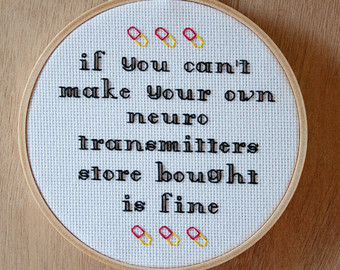
So today I took my first, very low-dose of Lexapro. It helped a lot to sit down and have a specialist really explain it all to me in a thoughtful way. The way he tells it, frequent depressive episodes train the brain pathways to be better at repeating that way of being and feeling, right down to modifying the epigenetic code. The reason antidepressants work is because they help you retrain those neurotransmitters into healthier patterns. It takes time but knowing that it doesn’t need to be permanent and there is actual hope for stopping someday really helps.

I was surprised that by the end of the conversation and even today as I took the first pill, I didn’t have fear around doing so. I’m actually rather excited about the possibility of feeling some relief and knowing for the first time that I can remember what it is like not to constantly fight my anxiety. We’ll see what happens now.


Keep fighting

How to even find the words today. I cried myself to sleep and I woke up weeping. Now I have run out of tears and moved past the denial. This isn’t a nightmare I am going to wake up from. This is a real life dystopia created by white supremacy, misogyny, transphobia, and homophobia. I fear for my own safety but even in doing so I know that being white and living in Seattle protects me from the worst of it. It is queer and trans people of color, Latino immigrants, and people surviving only because of our social safety nets who will bear the brunt of the pain as everything we have worked for is unraveled over the next 4 years.

I have struggled to find hope and the energy I need to keep fighting. But then I came across a friend’s post that is helping me get through the day.

Harry Potter is reminding me of what it means to fight against power, even when evil rises. So I’m going to keep using that metaphor and work to build a real-life #DumbledoresArmy to fight against #PresidentVoldemort. Will you join me?

If you need to go “underground” for protection and hide parts of who you are in certain situations, then do what you need to do to be safe. If you can stay inside the Death Eater controlled Hogwarts and Ministry of Magic and fight from inside, then please do so for the rest of us. But whatever happens, don’t give up hope. Don’t stop fighting. And don’t stop being your most authentic self.

Stand up for trans rights, for reproductive choice, for immigrant welfare, for healthcare access, for the lives of those who are being hunted by the police, and all the other vital human rights that our new government will attempt to destroy. Don’t let your voices be drowned out by hate. And remember that your working class white neighbors aren’t the real enemy. Show them love and build relationships (as far as you can safely do). It is only by knowing people who are different from them that they can change.

A cautionary tale

I’ve spent most of my life making decisions because I wanted to please others, make life easier for other people, or be likable. It’s been a consistent theme for me that has shaped so much of who I am, including why I am an administrative assistant today. My job is all about making someone else’s job easier. In the nonprofit world, that can be a good thing because I’m working for worthy causes and helping others use their talents. But in most areas of my life, it isn’t serving me well and ultimately it really isn’t helping other people in the way that I think it is.

I spent my childhood trying to live up to the standards of a fundamentalist form of Christianity.  It had very gendered expectations about my role as someone who was supposed to grow up to be the patriarch, decision maker, sole bread winner, and father. I tried so hard to live up to those images and in my various attempts I fell prey to some aspects of toxic masculinity. By the time I was 18, I was a poster child of obedience and conformity. I went off to college able to debate with the best of them on the apologetics of Calvinism and prepared with a stack of books about creation “science” to argue with my “liberal” Christian professors.

But I came to the realization at 18 that even within my closed circle of Evangelical friends, I was a real asshole and unpleasant to be around. In attempting to please my church and my parents, I had turned into a judgmental person stuck in black-and-white thinking. Because I wanted everyone else to like me, I resolved to change… or at least to be less vocal about my judgments and take more time to listen.

Luckily for me, my choice of an Evangelical liberal arts university gave me the opportunity to grow and change in a non-threatening environment. Within 2 years I had transformed into a liberal pacifist and thrown my conservative history behind me. But I hadn’t stopped trying to please other people. When my best friend expressed romantic interest in me, I ignored the warning flags about her personality and dove head first into an all-consuming relationship which found me married before my junior year at only 21.

I spent the next 7 years doing everything within my power to please her, bending over backwards and almost completely losing myself in the process. She was controlling, manipulative, gaslighting, and emotionally abusive. She used my self-abasing tendencies to her benefit and had me convinced that her opinions were right on everything. My feelings were unimportant. Under the guise of wanting me to “fulfill my true potential,” she molded me into the type of person that gave her the status of a successful married professional that she wanted to be in her life.

We had the beginnings of a sexual relationship when we first started dating but that all but ended once we got officially engaged. We didn’t have intercourse until 5 years into the marriage and she used that as a dangling carrot, always something in the future to be working towards if I did the things she wanted. The only reason we ever even tried it (very unsatisfactorily) was because she knew she was losing me. As a sexual person I was deeply unfulfilled in our relationship but whenever I would voice that it would become all about her.

Slowly she trained me to basically be her servant, fetching anything she wanted and meeting her every need. She demanded massages which began as an exchange but eventually became something I would just do for her. Even when I was working 10 hour days she would still expect me to come home and do all the cooking and household chores. I passed this off as a positive thing because we didn’t have gendered roles in our relationship, but really it was just abusive.

When I would try to talk about my needs and desires they were pushed aside in favor of her needs. If I used emotional content in a conversation my feelings were dismissed because she only believed in logic (until her repressed feelings would inconveniently bubble to the surface in which case I had to sooth her). I was always set up to fail when we argued because she had training as a debater. In public I was the dutiful husband and we were the “power couple” at our church, but in actuality, I had no power.

Despite all that, I didn’t talk about my problems to anyone else because I didn’t want to burden anyone. In my attempts to make others’ lives easier, I allowed mine to become a living hell of consuming depression. I would pathologically avoid being alone with my feelings because they would lead to very dark places. There were times I think that the only thing that kept me alive was that I didn’t want to die a “virgin.”

I tried so hard to volunteer and do good things during that time but I was unable to really be effective because I hadn’t taken care of myself first. And because daily life took so much work, I put my own self-discovery on the back burner. All my gender feels turned into a festering anxiety in the background.

After 5 years of a very unhappy marriage and couples therapy, it was so clear that things weren’t working that we were having serious conversations about divorce. But I was still so stuck in the model of meeting everyone else’s needs before my own, including not disappointing my parents who didn’t approve of divorce, that I agreed to stay. I did finally prioritize one thing though. It was important to me that I have a sexually fulfilling life which was never going to happen with my wife. She wanted any outside relationships to be a sex only arrangement but that’s not what fulfills me. So we compromised and I was “allowed” to pursue polyamorous relationships under some very strict rules and in secrecy.

Through reading resources on polyamory that focused on the importance of knowing your boundaries and finally seeing models for healthy relationships, I slowly began to come into my own and prioritize myself little by little. This resulted in a backlash at home as my wife could see her perfect arrangement slipping away.  But I was able to see the world outside the bubble I’d been isolated in for the first time and find people more like myself who were comfortable in their gender and sexuality.

When I finally came out as genderqueer and pansexual, she wanted me to keep it secret from all but a few confidants because she didn’t want to have to answer questions about my gender or her feelings about my sexuality. That was what finally started to break down my mental block around divorce and got me thinking about what it might look like to truly love my life and myself. Still, I was so afraid of being unloveable that I stayed in a marriage where love was conditional on my continued silence and suppression of my identity.

Polyamory isn’t easy, especially when you are starting out and have a lot of restrictions placed on you. My wife would yell at me if I was 3 minutes late coming home from a date and she wanted me to tell her everything that was wrong with the people I was dating and why she was better than them. But after a lot of dating attempts that never made it past the third date, I began dating a wonderful woman who encouraged me to voice my needs and set boundaries. It started out as a casual relationship with no expectations but within a couple months it was clear that I was in love.

That brought things to a breaking point in my marriage. I was starting to be happy and learning to say no to unreasonable requests and my wife couldn’t stand that. After 4 months in that relationship she changed tactics and was suddenly interested in sex. But it came with strings attached. She wanted me to choose between her (and a straight monogamous life) and polyamory.

Luckily by that point I had done enough self-work that I was able to connect with my feelings and consider what I actually wanted. My therapist asked me to focus on the sensations in my body as I imagined my future in both scenarios and immerse myself fully in the feelings of both options. It took an agonizing few weeks as I wrestled with that decision, getting pressure from my wife the whole time. I will forever be grateful to my girlfriend who stuck with me in a fairly new relationship through that uncertainty and allowed me to make that choice for myself.

In the end it was clear what I needed to do. As uncertain as my future was if I left, I knew that I would be forever unhappy if I continued to give so much of myself up to be in that marriage. Leaving was the hardest thing I’ve ever done but it was also the best decision I ever made. I moved in with my girlfriend, temporarily at first, but I took steps to make sure that I didn’t fall into old patterns of pleasing others at my own expense. 18 months later it still takes a lot of work to undo those old patterns, but with the memory of those experiences still fresh in my head, I keep at it.

My life now is radically different, not just because of my lifestyle, but because of how I am treated by my partners and how I treat myself. No longer do I accept relationships where there is an unsustainable imbalance of emotional energy or physical labor. All three of my long term romantic relationships require investment, commitment, and a good deal of energy. But because I know what my limits are, where my boundaries are, and how to say no, I have the ability to do far more for others than I ever was before. That means seeking out relationships with people who also value consent and prioritize their own self awareness. It also helps that none of us rely solely on one person to meet all of our needs. We each have other relationships, both romantic and platonic, that support our emotional and physical needs. We have all structured our lives together in supportive community where vulnerability is valued and intimacy is not feared.

Now my life is my own. No one owns me no matter what happens, no one can tell me what I feel or who I am. And that is why it is so important to me that my gender isn’t about who I’m in relationship with (and how they define their sexuality). I won’t let it be simplified or hidden to make things easier for other people to understand or be more comfortable with. My gender is complicated and it can feel like it makes things “difficult” for others (and for me) but not living as my fullest self causes far more harm to myself and ultimately to my ability to actually help others. The airline announcements are true – you do need to put on your own oxygen before helping the person next to you.

Infinite Love

So I want to talk about one of my biggest barriers to coming out and living as my truest self. The fear that nobody would love me. Hardly a unique phobia and certainly not specific to being trans. But it can hold you back if you let it.

I first started exploring my gender in college when I began accessing language to describe my experiences. I think that trajectory would have led me to coming out 5 years earlier if it hadn’t gotten sidetracked by getting married at 21. It’s a long story and off track for this blog but besides getting married too young we had a multitude of other problems that were apparent pretty early on in my 6 year marriage. And all of those problems meant that my personal growth got put on the back burner.

The biggest thing that contributed to me getting in that relationship in the first place and held me back from letting go of it when it wasn’t working was my fear of being alone and not finding someone who would love me for being me even as much as she did. When I did finally discover myself as a genderqueer pansexual, my wife asked me not to come out widely because she didn’t want to answer questions about my identity and sexuality. That alone should have been a sign that I wasn’t actually loved for who I was but yet I clung on for another 4 months before I got the nerve to leave. All because of this irrational yet common fear.

What I found beyond the confines of my straight, monogamous, ciscentric marriage was a world of infinite love and a community where I could be accepted both for who I was now and for who I would be tomorrow. I found my way through OKCupid and Meetup.com groups into the vast, semi-secret world of queer polyamory.

For those not familiar, polyamory is a form of ethical non-monogamy focused on informed consent of all partners involved and centered around the idea that love is not a finite resource to be hoarded but an infinite pool that only grows when love abounds. Time is of course the limiting factor and everyone has a practical limit to the number of authentic relationships they can juggle, whether that is friends or intimate partners. But in poly I found both friends and partners (and many shades in-between) who are unafraid to use the word love, who can open up the vulnerable parts of their hearts honestly, and who embrace my identity, even when they don’t understand it.

Today I have an amazing fiancee who I live with, two wonderful girlfriends with partners of their own, and a multitude of friends and lovers in community with each other. All of us encouraging each other to be ourselves and love ourselves as we are.

I’m not going to pretend it’s a magical fairyland with no problems or transphobes but beyond the heteronormative veneer you see in the press, the poly community I have seen is the most accepting place I can imagine. And more importantly, I learned that it’s ok to be “picky,” that I should and could be loved for who I am, and that I don’t need to be everything that one partner might need.

I’m not saying polyamory is for everyone or that it is the only way to find love outside the binary. That’s just an important part of my story in finding access to the idea that love is not finite. The key detail here is that you can find people who love you for who you are and you don’t need to compromise your identity to be lovable. But that fear of loneliness and the concept of love as a scarce resource are barriers to finding that happiness.

Live your life proudly and boldly as your truest self. I believe that is the sexiest thing you can do. And when you do that, people will want to be around you and you have a better chance at finding someone who loves you as much as you hopefully love yourself. When we hide who we are we lose our best shot at authentic relationship with other human beings.

Sure, you may lose some “friendships” that you never really had in the first place. But I bet you would lose them as soon as something serious happened in your life anyway. And there are real and tangible dangers to being out and visible. But find the places were you are safe, the communities where you can be real, and do exactly that. Be REAL, authentic, vulnerable, and honest. Once you start letting go of the idea that you aren’t deserving of love (which can be a lifelong process) then you can find it.


Being genderqueer at work

This week I did what felt like a really big thing for me – I asked my supervisor about wearing feminine clothing at work. And while I had built it up in my head as this huge conversation, it was actually very chill and amazing. She was fully supportive of me wearing a diversity of professional clothing that felt comfortable to me and didn’t have gendered expectations of what that looked like. I felt so valued and respected that I walked out of there and immediately gushed on Facebook about how wonderful it was.

This wasn’t the first conversation we had about it but this felt like the biggest deal to me. I started this job 7 weeks ago after leaving a job I had been at for 3 years where I came out slowly while working there. No one at my previous company treated me badly because of my gender and I had several wonderful allies there, but most people didn’t really seem to get it and didn’t ask questions to understand. When I tried wearing more gender affirming clothing I got less compliments and people seemed a little awkward around me. So I eventually gave up trying until my last week when I stopped giving a fuck and came into work in dresses and skirts.

I’m not the greatest about asserting my gender and pronouns and I feel incredibly awkward having the “coming out” conversations at work. My role is very service oriented and the mindset of making everyone else’s job easier is hard to break. I chose when I was interviewing not to come out and I dressed in fairly masculine attire (with purple in my shirt of course) based on the advice of a couple trans women I spoke to who said that getting the job is ultimately more important than being yourself all the time. But when I was starting to be introduced to new colleagues with he/him pronouns it felt really weird. I didn’t want to correct my teammates while they were talking and embarrass them so I didn’t know how to come out tactfully. When I finally had a moment to breathe and sit down at my new desk I decided that I wanted to just get it off my chest and tell all three of my main teammates at the same time.

I sent this email to them on my first day:

I keep forgetting to mention this when we’re talking and I’m a bit shy about correcting people but I thought I should tell you while we’re still doing introductions and meeting new people that I prefer they/them pronouns for myself. I’m genderqueer which is a nonbinary trans identity. Happy to talk about it more but I wanted to let you all know while I’m thinking about it.

Example: This is [Genderbeard]. They are the new support staff for Dr [X].

I was happily surprised to quickly get supportive responses from them AND to have them immediately start using my pronouns in emails and introductions. They stumbled a bit of course in the first few weeks but so do I, even referring to myself in third person sometimes. I’m happy to say that my boss has not only consistently used them for the past few weeks but she corrects others in the office when I’m not there. She said the example sentence was particularly helpful which is something I should keep in mind.

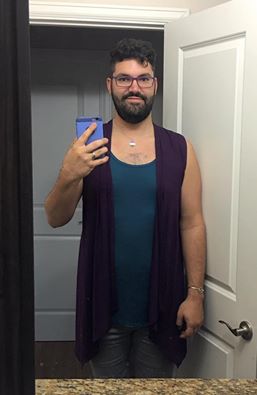
14068270_10154337504049360_7239371262427352616_nThe first few weeks on the job I continued to dress in what most people would perceive as gay male fashion (bright collared shirts, fashionable shoes, colorful pants) partly because I was testing the water of the office culture and mostly because I didn’t have professional level femme clothing yet. But the last couple weeks I have started to incorporate more androgynous blends of colorful “men’s section” pants with blouses. On the quiet summer day I talked with my boss, this is what I was wearing. ->

In our conversation she not only affirmed that the only expectation was a professional level of clothing appropriate to the day’s activities and guests but emphasized the non-gendered nature of our dress code. She told me she already had conversations with HR about how she and them could best support me only to sadly find out that they had no clue and no resources. When they jumped to wanting to use me as a spokesperson for all genderqueer people at the company, she defended me and emphasized her view about treating me with respect and not tokenizing me. Needless to say, I was overjoyed with her response and I feel incredibly lucky to have found this job and this team.

To make an already long story short, the take home message here is that sometimes your own fear is the biggest barrier (and the financial resources to buy new clothes maybe). If you take a risk and put yourself out there you may be pleasantly surprised by the response. I agonized for weeks over how to have these conversations and when I did I was met with only support and respect. I’m so glad I took the risks I have and I’m excited to continue building up a professional wardrobe and sharing it here.