My coming out post

It’s hard to believe that I’ve only been out of the closet for 4 years. Coming out is a ongoing process in many ways but for me, I mark the moment that I first made a Facebook post to all my friends about my identity. My identity and thinking on terminology and pronouns has changed a lot since then but here’s what I said on June 2, 2015:

Hey folks, I’m Queer!

If you hadn’t figured that out yet, don’t worry! It took me a long time to recognize that in myself and even longer to put words to it, and I’ve never explicitly said it online. More specifically, I identify as Genderqueer Pansexual. And since it’s LGBTQ Pride month, this seems like an appropriate time to officially come out.

Because my gender expression is still masculine(ish), most people perceive me as a cis hetero male, and for most of my life that’s what I tried to conform to. In college our campus LGBTQ discussion group introduced me to the concept of gender nonconformity. For several years that’s how I identified, but it didn’t quite seem like that adequately described my experience of, and sometimes dysphoria about, my gender. So over the last year, I’ve paid more attention to those parts of myself and come to realize a few things.

My gender is complicated, which is where genderqueer comes in. I have never fit comfortably within the standards of masculinity – whether by the American definition, the Evangelical Christian expectations, or in comparison to the experiences of the majority of men I have interacted with. For most of my life I merely accepted being “odd”, “feminine”, “sensitive” or even a “sissy.” But recently I’ve realized that there are other people like me who don’t fit in the binary definitions of gender and that my gender expression doesn’t define my gender identity. I can have a beard and still be non-binary.

Just because the majority of people with a particular body part between their legs tend to act and think in common with one of the two main groups that looks like them doesn’t mean that gender is exclusively binary. There are many people who embrace a non-binary identity like genderqueer. Some choose to change their pronoun to something neutral like “they/them/theirs”. For me, I still choose to use “he/him/his”, but the important part is that this is a conscious choice and I really enjoy being in communities where people ask about pronouns rather than assume.

Genderqueer for me means that I am my own special mix of conventionally male and female behaviors and ways of thinking that don’t really fall easily on a two-dimensional spectrum. I have never identified with other men. I feel very uncomfortable in any men-only groups and I have always sought out the friendship of women, though I did not fully identify with them either. However, feminism has given women some degree of freedom to express a spectrum of gendered behaviors, making “tomboys” and others more normalized. So more often than not, I find that women are more likely to be accepting of my gender nonconformity while men are frequently uncomfortable or at least don’t know how to talk about it maturely.

When it comes to my sexuality, I’m attracted to the person. What is between someone’s legs is not the determining factor for whether or not I am attracted to them. Each person is unique and I experience attraction towards people of all genders, but particularly those who don’t fall completely within the traditional gender binary. Pansexual is a subset of bisexuality for me but specifically calls out my attraction towards other gender-nonconformers and people on the trans* spectrum (not that bisexuality can’t include that).

Some of my friends may have heard me allude to or mention parts of this recently but I have not been very transparent in how I use these terms or inviting of dialogue. So here I tried to lay out the basics but I invite you to ask questions and help me further explore what this looks like for me in relationship with others. This is an ongoing exploration and I don’t know what the future looks like in regards to that evolution, but I hope you’ll join me in finding out.

Because I am white and masculine presenting, I have a lot of privilege in how I come out and who I tell, especially when I am with feminine presenting partners. That’s why it is particularly important for me to come out and speak openly about gender and bisexuality; countering the gender-policing, transphobia, biphobia and monosexism present in both mainstream culture and in homonormative circles can only happen when people speak their truth. I want to use my privilege in positive ways to speak up while it’s not safe for others to do so, though I will try to be clear about only speaking to my experience and not speaking for everyone.

There are a lot of reasons it took me that long to come out, but the biggest one was my first marriage. I started to figure out that I was genderqueer at least 8 months before that post when I started dating other nonbinary people but when I told my wife, she wanted me to stay closeted so she didn’t have to “answer any awkward questions.” My marriage had been doomed from the start for many reasons but that was the beginning of the end. You should never be in a relationship with someone who doesn’t want you to be your most authentic self. But coming out is not always safe and I had to wait until I had escaped that marriage before I could say something broadly.

Leaning into my gender exploration is the best thing I have ever done for myself. I truly think that everyone should have a good hard look at their gender and sexuality before assuming they are straight and cisgender. Because you never know what you might be hiding from yourself.
Dysphoric Bandaid Beard

There are times when I wish I still had my beard. In a lot of ways it was like a security blanket for me, allowing me to exist without having to constantly focus on my dysphoria around shaving and my chin shape. When I first grew it of course I had no idea what dysphoria was or why I hated my face so much, but I used it as a crutch for 12 years.

When I made the decision last fall to get rid of the beard, I knew that my dysphoria would get worse before it got better. And it most definitely has. It is starting to get better now that my growth rate and amount of active hair follicles have been reduced from laser therapy and electrolysis, but the first few months were hell.

Ultimately, the reason I chose to shave was because I chose to believe that it could be better eventually. That somewhere down the road I could be happier and less dysphoric than the low level that I was at with my beard. Sometimes it is hard to see through the high level of dysphoria I have now to that hope that I held for a better future. But I have to keep reminding myself that transition is just a stage in my life and the point of it is to pass through it to emerge from my cocoon as the beautiful butterfly I am.

I am lucky to be surrounded by wonderful people who constantly tell me how beautiful I am at every step along the way. But the thing is, attractiveness feels good but it doesn’t alleviate dysphoria. Dysphoria and dysmorphia aren’t the same thing. The only way to treat dysphoria is by addressing the medical and social needs around gender affirmation. Words alone can’t cut it. But luckily we live in an age where we have plastic surgeons who know what they are doing and are constantly refining the process to create and re-form the body parts that we need.

Thanks to a new trans friend for the title of this blog post and some of the thinking behind it. Maybe someday I’ll make the queer band to match.

Selfies are hard

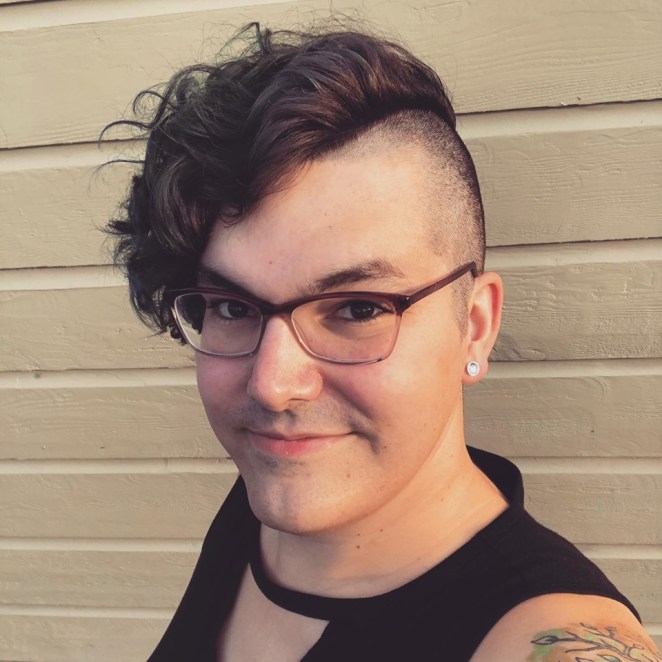
Dysphoria is hard ya’ll. I took a selfie yesterday after my haircut that everyone agrees is objectively hot and at the time felt like a really good photo of myself. But today when I look at it I have a hard time not focusing in on how much more prominent my chin looks now that my upper cheeks are widened by my first jaw surgery. It gives the illusion that I’ve lost weight because my face comes more to a point but to my dysphoric brain, it seems like it REALLY comes to a point.

Luckily, I’m going to have my chin reduced slightly during my second jaw surgery, probably in December. It is nice to know that there is potentially an end in sight to this source of dysphoria. And I am chugging away on laser hair reduction which is slowly making that source easier to handle. But it is still frustrating to have my day derailed by those obsessive thoughts.

Next up on my to-do list – call my top two surgeon choices in San Francisco to set up a consult for my bottom surgery (vaginoplasty).

61756817_10157152208944360_1997429246003249152_n

I just want to be seen

So I was watching BoJack Horseman this morning. I’m in Season 5 at the moment and I was watching the episode “Free Churro” where BoJack is at his mother’s funeral and is giving this very bitter eulogy based on his childhood trauma. But at the end there is this moment where he says something about how we all just want to be seen and the saddest part of his mother’s death is that he no longer has the opportunity for his mother to see who he really is. And even though I was only half paying attention, I start crying. And I’m crying again writing this out. Because ultimately, that’s what is most important to me too. I just want the people in my life to see who I really am. Not see my body or the person they thought I was based on how I was born. But the woman I truly am. And my mother is the person who I yearn to see me the most.

So when I talk about the pain of being misgendered by my family, it’s not actually about them making a mistake. It’s about the fact that when they do that constantly, it feels like they don’t actually see who I really am. They still think of me as the boy they thought they were raising. They probably still think this is a phase or that I have been corrupted by liberal society or something. And they can’t seem to successfully convert their brains to seeing who I truly was all along.

I have largely given up on my dad. I don’t think we will ever see eye to eye. But I guess I still hold out hope for my mom. And more than almost anything in my life, I want her to see who I am. I want her to embrace me as her daughter and give me her approval.

In my family, there is a middle name that started with my grandmother and has been passed down three generations in the women. It is my mom and my sister’s middle name and since in many ways, our family is not so secretly a matriarchy, it is a very important symbolic name. As I think about changing my name to make my chosen name my legal first name, I have been thinking about what I want my middle name to be. And a large part of me is drawn to choosing that name because of the symbolism. But I feel like I need to be given permission to claim that heritage and while I have gotten that from my aunt, I still feel like I need my mother’s seal of approval. And I know it probably won’t happen as long as she doesn’t see me as I am.

Most of my trans friends don’t have that relationships with their families anymore because they have either been rejected by their parents or they choose to distance themselves because of the pain that being constantly misgendered and deadnamed causes. But I keep trying to invest time into my family and I remain close to them even though it is painful because I want that closure. I want to be seen. And I truly hope that before my mom descends into alzheimers, that I get that moment with her.

Biological “sex” isn’t real

I’ve written many time before about how the concept of biological sex as a separate concept from gender is artificial. And how asking it on forms as if it determines everything about me medically is inaccurate. But I want to revisit the topic because it is really important. MANY cis people, both men and women, use this as a prop for their transphobia and make arguments based on biological determinism. When really, it is just based on internalized oppositional sexism, misogyny, and homophobia.

The main argument rests on the idea that your X/Y chromosome mix determines everything about you. But that is just a prop for our pre-existing binary thinking. I don’t think it’s a coincidence that chromosomes were first identified at a time in Western history where people were already socially trying to reinforce gender roles based on a patriarchal lens. And even they acknowledged that there are 5 “sex” chromosome combinations.

When you think about it, the only genetic difference between people with XX and XY is in 1/8th of 1/23rd of your genetics which works out to 0.5% of your primary genetic code. Half of that if you consider the recently discovered epigenetic component which is shaped by your environment and experiences in life. There are far more differences on other chromosomes than there are based on the Y.

And in reality, our genetics are only a small part of what makes us who we are in life. If you are really going to claim biological determinism then you need to look at the whole biology of a person. Which includes how their body was shaped by hormones in the womb, how their brain developed, and how their body has changed over time. And there are already studies that show that in many trans people, there are key areas of the brain that are more similar to their gender than to their chromosomal peers.

There is also recent data showing that bloodwork values on trans people taking hormones closely match their hormonal peers after only 6 months, regardless of the concentration of the hormones. So it brains and blood match and hormones only play a small role, that only leaves genitals.

The existence of intersex people due to natural variation in human biology already proves that genitals aren’t binary either. And with modern medicine, we can fundamentally change the shape of your genitals to the point that the average person can’t tell the difference between a neovagina and a natal vagina if that is your desire. So really, what is our excuse anymore? You can’t claim socialization because many trans people fundamentally experience their childhoods and lives differently. It really just boils down to oppositional sexism, misogyny, and homophobia.

So cis people, next time you hear an asshole say that they would never have sex with a trans person, or a TERF say that only cis women belong in their communities, press them as to why. Help them uncover their homophobia and transphobia. The burden for undoing that shouldn’t lie on trans people. We shouldn’t let jokes about “discovering someone used to be a dude” slide. Because those are just as much a part of rape culture as jokes about how women should dress.

And remember, just because you may hear at a Trans 101 training that sex and gender are different doesn’t mean that all trans people agree. Send them this blog and remind them that their argument isn’t based in science.

How long it takes to come out

Something that I have a lot of internalized shame about is how long it took me to figure out that I was trans and act on that. Looking back at my childhood, all the signs were there, though they certainly weren’t obvious at the time. And a lot of that is because I didn’t know that trans people existed. I assumed I must be the only one who felt like this and that there was nothing that could be done about it, outside of a miracle.

But the more I learn about psychology, sociology, trauma, and all that other brain and social determinant stuff, the more I realize that there were plenty of good reasons that I didn’t come out until I did. My brain was protecting me, keeping me safe until I was in a place where I could be myself without as much risk of harm. Or at least it was trying. Sometimes you just reach a breaking point and you can’t avoid it anymore no matter what your situation.

After my very conservative childhood where I was isolated from knowing any out queer or trans people, I went straight into a conservative college. I started to meet gay men and even some queer women, but I didn’t know anyone who was trans. The first out trans woman I met had a more binary path than me and I still had a hard time imaging following that path. I did start to think about expanding gender a bit around that time as I began identifying as gender non-conforming. But I still thought that meant that I was a feminine man.

I feel like I was on the verge of finally figuring out my gender and sexuality when I got sucked into a relationship with my then best friend. It was one of those unhealthy relationships from the start where she demanded all my attention and frequently alienated me from my friends. Partly because of my own lingering baggage from the form of Christianity I was still coming out of and partly because I needed a way to pay for school when my parents tried to control me, we got married after only 11 months of dating. But as soon as we got engaged and she no longer felt the need to woo me, things went downhill fast.

From my wedding night on, my life became about compromising who I was to make her happy. I no longer had any energy to figure out my gender and sexuality because I was fighting just to keep my head above water and try to figure out what was wrong with me and my marriage. I spent 6 more years like that, struggling with crippling anxiety and depression as the abuse continued and my mental health was shamed. She loved taking advantage of my feminine traits when they suited her, like manipulating me into doing most of the cooking and cleaning and emotional labor. But she had a vested interest in keeping me from going past the point she wanted.

During that time my brain didn’t allow me to think about my identity. I hid the most vulnerable parts of myself away deep inside a shell to protect them from the violence in my relationship. I spent most of what little free time I had avoiding any deep reflection. I had finally escaped religious abuse only to find myself in a much more intense form of emotional abuse.

But eventually I reached a breaking point in my relationship. We went to couples therapy for 5 years and finally after 4 years of making no progress on how to make an asexual person and an allosexual person compatible sexually our therapist suggested opening up our marriage and exploring polyamory. My ex had no interest in dating but she begrudgingly allowed me to date because she knew at that point it was the only way to keep me. It was a terrible place to be dating from but it did allow me to finally get farther out in the real world outside of her influence and eventually meet queer and trans people.

It was the first trans person I dated who really helped me think about how I might be more than just gender non-conforming and how to expand how I viewed genderqueer identity. And once I started to unravel that ball of yarn I couldn’t stop. I wasn’t safe yet but that catalyst was all I needed to start myself on the journey to where I am now. Having that person (who is still a dear friend of mine) give me permission to think about the thing I had been avoiding for all my life allowed me to start to think outside the trauma I’d been experiencing.

My ex didn’t like that however. When I came out to her as genderqueer and bi she immediately told me not to tell anyone else because she “didn’t want to have to answer awkward questions.” That was the beginning of the end for our relationship. I had finally taken a huge step forward in becoming myself and all she could think about was herself. She was also deeply biphobic because she was convinced this was me becoming only attracted to men (which doesn’t make sense when I’d wanted sex with her for 7 years).

Shortly after that though I started dating the queer woman who is now my spouse. And she showed me what it felt like to be truly loved FOR who I am, not despite it. She has been the most gender affirming person I have ever met and at each step of my transition she has made it clear that she loves me no matter what direction I go. She doesn’t have a specific outcome in mind for me except that of becoming my most authentic self.

I pretty quickly realized I need to leave my ex so I moved out 4 years ago this month and came out publicly shortly thereafter. I have now filled my life with other wonderful people, cis and trans, queer and straight, who affirm me like that as well. If you had told me only 5 years ago that I would be here now, I would have either laughed or cried. It felt so impossible to imagine ever being on a pathway to happiness at that moment.

So when I see people come out, especially later in life, I feel so much love for them. They have finally broken the chains of their trauma and societal expectations and set themselves free. I don’t hold any judgement for how long it took them because I know that often times that was for their own safety or lack of resources. They had the courage to not let their past define their future. Which is a lesson I think everyone could learn from.

Adding stories, not replacing

So I see a lot of trans people harp against the “wrong body” narrative. And in a way I get it, especially when that is the only narrative that cis people seem to be able to hear.

But the thing is, it is true for some of us. Particularly after puberty I frequently thought that I had been given the wrong body even before I knew what trans people were. An analogy I used yesterday was that it feels like I had the wrong hardware installed for my operating system. I’ve finally gotten the wiring right (estrogen) but I’m still working on replacing the casing.

We shouldn’t have to replace the “old” narratives of transition in order to expand them. What we need is more diversity of trans stories being elevated. Those stories are already being told but allies aren’t always listening and boosting those stories in the same way as the nice, neat, clear-cut narratives. As long time followers of my blog can probably tell, the real journey is messy. It doesn’t always involve absolute certainty about the steps and questioning your decisions is a normal part of any medical intervention or major life shift. Not following the cookie-cutter story should absolutely NOT be a reason to deny a trans person care.

So I invite you to listen to stories that challenge you. Narratives that don’t follow the path that you would expect. Parts of them may still fit the story we are used to but that isn’t the complete story either. We just need to expand our view of trans diversity. Because trans people are at least as diverse as cisgender people. We can be queer or straight or asexual. We can be binary or nonbinary or not even have a clear sense of gender. We can have dysphoria or we can simply find our path through gender euphoria. We can be neurotypical or neurodivergent. We can be fat or skinny or somewhere in between. We can fit a modern western story or follow in the footsteps of our transcestors who come from hundreds of cultures spanning thousands of years. Those things don’t need to be pitted against each other like some sort of competition for being the purest trans.

Your job isn’t to gate-keep and ensure we are absolutely 500% positive before we can receive the gender affirming care we need. Your job is to listen to us and let us guide our care. So listen to ALL of us, not just some of us.

Gendered Clothing

Figuring out clothing in a gendered world is so complicated. There are so many things that I found before I began transitioning that are comfortable and look good on me but that I hesitate to wear because of how they are gendered or perceived. I wish I could just wear whatever felt good to me without having to worry about overcompensating on my gender expression in hopes of being read more accurately in the world.

Every choice I make about how I dress impacts how people see me. If I was a cis woman, I could take advantage of the full range of clothing and most people wouldn’t question my gender. But being a non-passing trans person, I feel like I need to dress a certain way to signal to both cis people and other trans people that I’m not a man. My options are opening back up a bit more now that I actually have more feminine curves but I still have to think about it daily. Is what I’m wearing going to be perceived sufficiently feminine to legitimize my identity?

Growing up I had zero sense of fashion. There were a lot of reason for that. For one, I was homeschooled so I didn’t have a lot of examples of what other kids were wearing. For another, there was a lot of pressure to fit the mold of conservative Christianity and I was constantly being told to put on collared shirts or cheap slacks which wouldn’t look good on anyone. And to this day I can’t stand to wear navy blue bottoms with white shirts because that was the cult uniform. But mostly, I was just awkward in my body because guess what, I was trans!

Whenever possible I would dress down in sweats or jeans and a tshirt. Mostly that was because so much of the time I had to dress up for church or to be presentable at some event and when I did so I was deeply uncomfortable. Because the more “dressed up” you get, the more gendered clothing becomes. Suits and ties are a strong indicator of gender (or sexuality depending on your body). And because that was the wrong gender, I felt very awkward in my skin whenever I wore them. I was constantly complaining that I felt strangled by ties and I hated wearing suits. I rationalized those by telling myself it was because I had a wider neck and got hot easily. But really, I was chaffing at the expectations that came along with them.

Once I became an adult I cycled through many different styles trying to find a way to be comfortable and still professional. Most of the time I ended up looking rather preppy but rarely was I what you would call fashionable. I started to get there towards the end when I was dressing more like a flamboyant gay man. But I honestly have no good sense of straight male fashion. I wanted to wear what the beautiful women around me were wearing.

Rarely do I wear high femme outfits like fancy dresses and heels to work. Because that’s not the kind of person I would normally be. And when I do wear something to an event like that it is often because I view gender as a costume or I’m overcompensating for how the rest of my body is perceived. For so much of my life I thought I was a feminine boy when really I was just a tomboyish girl. I just wish I could dress that way without being seen as a man.

Reflecting back

Dysphoria is such a weird brain trip. There are days like yesterday where I look at photos of me even a year ago when I had a beard where I can barely recognize that as the same person. The me I see in the photo seems more like a long lost relative who I used to know well and is now a stranger.

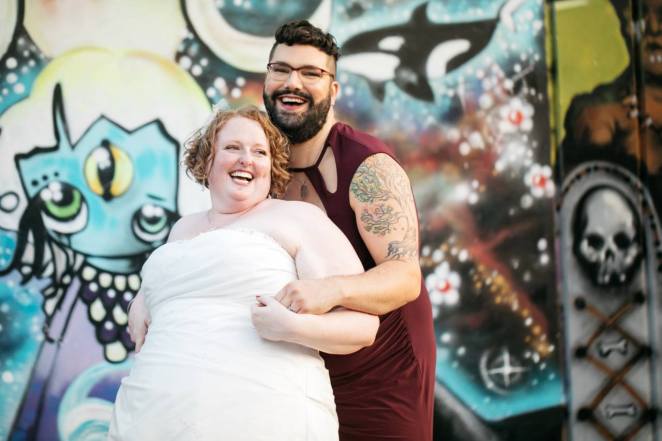
Then there are days like today where I look back at things like my wedding photos and I can put myself back in that moment. I think the times I can relate to my past self the most are times where I felt affirmed in my gender even if my presentation wasn’t what I wanted. My aggressively queer wedding was one of those moments. And my early childhood had a lot of those moments as well. It was after puberty started hitting and before I came into my own through my relationship with my spouse that are the hard times to look back on.

22550290_10155661448412332_8852752312265467863_o

Photo by Jenny GG Photography

Hypervisibility revisited

I’ve written before about the burden of hypervisibility as a trans person who is never going to pass or not be noticed everywhere I go. I even wrote a chapter about it for the anthology Nonbinary: Memoirs of Gender and Identity which comes out next week. But I do want to circle back around to that topic briefly.

I’m not entirely sure what exactly changed but slowly over the last year and a half since I wrote that essay, some of that burden has lifted. I no longer feel that constant pressure of eyes on me everywhere I go in the same oppressive way. It’s not that people aren’t staring, it’s about my perception of it.

It may be that I have simply developed thicker armor when I go out in public and like so many women before me, have had to learn to accept that unwanted attention is going to happen in a world where misogyny reigns free. Or it may be that I’ve redefined what that attention means. I no longer assume that everyone who I catch staring at me has ill intentions. I know from experience that the vast majority of it is probably curiosity or even good will. And knowing that I can’t determine the meaning in their gaze (unless they are openly videoing me and leering) has left me more open to generous interpretation.

Now I’m not trying to give you blanket permission to go stare at everyone you encounter who is “different” or edgy or whatever you want to call it. When I’m already raw from microaggressions, that attention still chafes. But having so much support at home, in my friend circles, and at work helps relieve some of that daily microaggression exposure so that I’m more able to tolerate things like misgendering and stares in public.

In a lot of ways, my dysphoria and mental health has gotten worse lately as I dive deeper into my self examination and awareness. And all I can do it to keep trying to find the energy to push forward in hopes that that burden will lessen as I get the gender affirming treatments that I need. But it is also helpful for me to look back and acknowledge these areas where life has gotten better and the things I thought would plague me forever have faded away from my conscious thoughts.