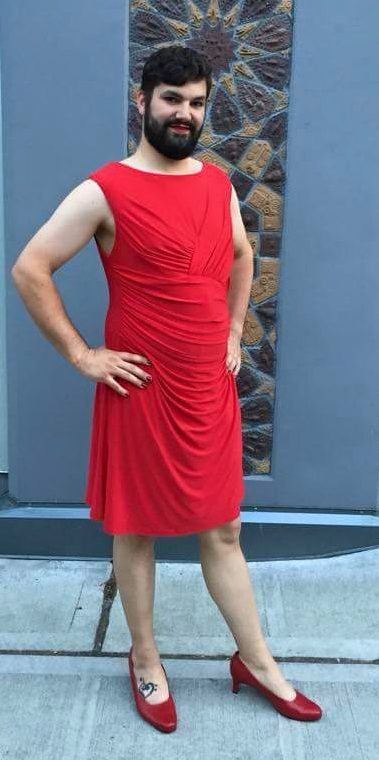
The week of skirts

I’ve never been able to wear skirts for an entire week before. Both because I didn’t own enough to not repeat and because I didn’t feel comfortable doing that at work before. But with the support of my boss and the acceptance of my team, I bought some additions to my wardrobe and wore skirts to work for 5 business days in a row.

I was really nervous about wearing skirts at work, especially the first time I met with the researcher I support. He has responded well to my gender fluidity at work but he is a middle aged white doctor from the rural midwest. But I have felt supported here and encouraged by my amazing partners to continue pushing boundaries and exploring the more feminine side of my gender.

What I’ve found so far is that I’m most comfortable in long skirts and I have a fair amount of discomfort and nervousness about wearing anything above the knee, especially with my hairy legs. Yes, I could shave but with how fast my hair grows that takes a big commitment. I have shaved them before and I love how it feels but not as it grows back. I did shave my chest for the first time this week to see if that made me more comfortable in feminine blouses that might expose some hair. I found that when I looked in the mirror like that it didn’t feel like me. It exposed my very masculine distribution of belly fat in a way that felt like it emphasized my dysphoria.

On the shortest skirt I ended up wearing tights which was a very professional look but wasn’t comfortable physically and didn’t feel like where I wanted to be gender-wise. Luckily fall weather has started here in Seattle so now I can go back to wearing sweaters which give me a great androgynous look.

Sex And Gender Are Actually The Same Thing (but bear with me…)

“Biological Sex” is just as much of a construct as gender and the two are intertwined too much to have separate dichotomies.

I particularly like this line:
“Trans inclusivity should redefine our understanding of gender and sex so that trans people are able to fit seamlessly within them (or better yet wouldn’t need to if the notions can be discarded entirely), not to have trans people straddle narrow, arbitrary classifications with certain parts of their personhood on one side of a line and certain parts on the other.”

Lane's avatarAndrogyneity

As you read the title, you may be overcome with indignation that this article is going to be a gender-essentialist rant. You’ll be relieved to know that it’s quite the opposite. My intent in writing this is to point out some serious misconceptions perpetuated in ‘trans 101’ and cisgender allyship resources, which end up doing much more harm than good for transgender people.

Anyone with an entry-level understanding of trans issues is probably familiar with the phrase “gender and sex are different things.”

While the idea of treating sex and gender as unrelated factors may result from an attempt to validate and support transgender identities, it actually perpetuates harmful cultural beliefs about the validity of sex assignment and the static nature of biological sex, which remove agency from trans and intersex people to define their own bodies and experiences. This way of thinking does nothing to combat (and in fact…

View original post 1,289 more words

The power of categories

Gender terms cloudTransgender

Genderqueer

Nonbinary

Gender non-conforming

Transfeminine

MtX

These are all terms I use to describe my gender. There are dozens more already being used and more being created every day to describe and categorize the diversity that we experience in real life. I’ve heard many people criticize identity labels and say things like “why do I need more boxes to fit in” or “I don’t like to label myself”. And while I’m not trying to invalidate their experience, I want to share a bit about why I love labels and categories, especially for gender and sexuality.

I think there is a lot of power in words. Words give us access to intellectual concepts and and language can be incredibly freeing when it is allowed to evolve and grow along with a society. For myself, I didn’t grow up with the concept of gender being anything other than what you were told at birth and it existed as an assumed binary. I didn’t know that trans people even existed until well into my teen years and I didn’t learn about terminology outside the basic LGBT acronym until I joined a highly controversial GSA-style group at my conservative Evangelical university.

Even once I had concepts for transgender and genderqueer, I didn’t really understand that there was diversity within those categories. I knew I didn’t want to be a woman (or at least didn’t think that was something I could access in any way that was meaningful to me but that’s another whole post) but I didn’t think I could be genderqueer either because I thought that meant I had to be androgynous in the sense that I couldn’t have any visible genderedness about my body. So for many years I identified as gender non-conforming for lack of a better way of describing my blurriness.

But as I began to add terminology to my gender toolbox I also began to see places where I might fit. It took until another trans person I was dating suggested that maybe I was genderqueer before I felt like it was something I could dare to explore. And even then it took almost a year before I felt comfortable claiming my place within the genderqueer and trans identities.

Sadly, a large part of that was due to my tendency to self-police my own gender and allow the “not trans enough” feelings to guide me. But I also didn’t understand that not everyone of a particular identity label has to look or feel the same. The key to unlocking my gender was grasping that these are merely categories, useful for finding other people like you but also for pushing the boundaries together of what it means to not be a cisgendered person.

Once I accepted that I didn’t need to desire surgical or hormonal transition above all else and that I didn’t need to lose all of my features that people ascribe to a specific gender (like my beard) I was able to accept that being trans just means not identifying with the (binary) gender you are assigned at birth. I was trans because I was not cis. I am genderqueer because I exist in a blurry space outside of the well-explored binary boxes. I am nonbinary because I don’t want to be a man but I know I’m not a woman. I may have been assigned male at birth but I can transition to be “X”. I can be feminine and have a beard.

So don’t let identity police get you down and tell you what you can or can’t be, especially not based on appearance. And don’t listen to those little shoulder devils whispering doubts in your ear about “being enough.” Claim the categories and terms that work for you now and don’t get hung up on how you might feel about your gender next year. It is OK to evolve and grow. It can be a step in your journey or it can be your final destination but either way it isn’t “just a phase.”

Being genderqueer at work

This week I did what felt like a really big thing for me – I asked my supervisor about wearing feminine clothing at work. And while I had built it up in my head as this huge conversation, it was actually very chill and amazing. She was fully supportive of me wearing a diversity of professional clothing that felt comfortable to me and didn’t have gendered expectations of what that looked like. I felt so valued and respected that I walked out of there and immediately gushed on Facebook about how wonderful it was.

This wasn’t the first conversation we had about it but this felt like the biggest deal to me. I started this job 7 weeks ago after leaving a job I had been at for 3 years where I came out slowly while working there. No one at my previous company treated me badly because of my gender and I had several wonderful allies there, but most people didn’t really seem to get it and didn’t ask questions to understand. When I tried wearing more gender affirming clothing I got less compliments and people seemed a little awkward around me. So I eventually gave up trying until my last week when I stopped giving a fuck and came into work in dresses and skirts.

I’m not the greatest about asserting my gender and pronouns and I feel incredibly awkward having the “coming out” conversations at work. My role is very service oriented and the mindset of making everyone else’s job easier is hard to break. I chose when I was interviewing not to come out and I dressed in fairly masculine attire (with purple in my shirt of course) based on the advice of a couple trans women I spoke to who said that getting the job is ultimately more important than being yourself all the time. But when I was starting to be introduced to new colleagues with he/him pronouns it felt really weird. I didn’t want to correct my teammates while they were talking and embarrass them so I didn’t know how to come out tactfully. When I finally had a moment to breathe and sit down at my new desk I decided that I wanted to just get it off my chest and tell all three of my main teammates at the same time.

I sent this email to them on my first day:

I keep forgetting to mention this when we’re talking and I’m a bit shy about correcting people but I thought I should tell you while we’re still doing introductions and meeting new people that I prefer they/them pronouns for myself. I’m genderqueer which is a nonbinary trans identity. Happy to talk about it more but I wanted to let you all know while I’m thinking about it.

Example: This is [Genderbeard]. They are the new support staff for Dr [X].

I was happily surprised to quickly get supportive responses from them AND to have them immediately start using my pronouns in emails and introductions. They stumbled a bit of course in the first few weeks but so do I, even referring to myself in third person sometimes. I’m happy to say that my boss has not only consistently used them for the past few weeks but she corrects others in the office when I’m not there. She said the example sentence was particularly helpful which is something I should keep in mind.
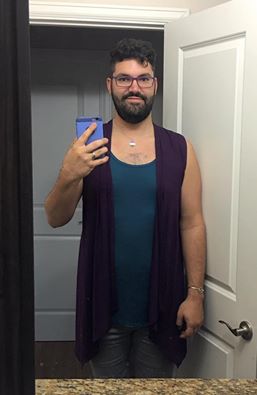
14068270_10154337504049360_7239371262427352616_nThe first few weeks on the job I continued to dress in what most people would perceive as gay male fashion (bright collared shirts, fashionable shoes, colorful pants) partly because I was testing the water of the office culture and mostly because I didn’t have professional level femme clothing yet. But the last couple weeks I have started to incorporate more androgynous blends of colorful “men’s section” pants with blouses. On the quiet summer day I talked with my boss, this is what I was wearing. ->

In our conversation she not only affirmed that the only expectation was a professional level of clothing appropriate to the day’s activities and guests but emphasized the non-gendered nature of our dress code. She told me she already had conversations with HR about how she and them could best support me only to sadly find out that they had no clue and no resources. When they jumped to wanting to use me as a spokesperson for all genderqueer people at the company, she defended me and emphasized her view about treating me with respect and not tokenizing me. Needless to say, I was overjoyed with her response and I feel incredibly lucky to have found this job and this team.

To make an already long story short, the take home message here is that sometimes your own fear is the biggest barrier (and the financial resources to buy new clothes maybe). If you take a risk and put yourself out there you may be pleasantly surprised by the response. I agonized for weeks over how to have these conversations and when I did I was met with only support and respect. I’m so glad I took the risks I have and I’m excited to continue building up a professional wardrobe and sharing it here.

Unexpected affirmations

I promised myself I was done posting for today but I just had the most amazing experience walking down the street in my very genderqueer outfit. I was heading to get coffee with a friend down a back street in Seattle on a scorching hot day minding my own business with my headphones in. Suddenly I see a guy across the street calling to me and waving me his direction. I’m skeptical but he seems friendly so I head to find out what he wants. Turns out he’s the shop owner of LICK Pure Cream and wanted to take a picture of me because my fuchsia and purple outfit perfectly matches his shop. He pulls out a pink waffle cone and fills it with blueberry chai ice cream on the house and asks to take a picture of me for Instagram in his iconic yellow chair. He even asked my pronouns. Sometimes life really surprises you!

**** Update 2017 – Sadly LICK went out of business so you can’t go meet the wonderful owner there anymore. ***

Also, I wanted to gush about how happy I am to finally have found some heel boots that fit! I’m size 13W in women’s and it’s nearly impossible to find anything, much less something both comfortable and stylish. But these David Tate shoes arrived from Zappos last night and look fabulous so I geared my outfit today around them.


What I’m doing here

I’ve never been much of a writer so I hope you’ll pardon any mistakes and infrequency in posts. But I believe in the power of seeing people like you and feeling like you’re not alone. So I’m putting myself out there to share a bit about my nonbinary “transition” such as is is and my thoughts as I seek to become more fully myself every day.

When I search things like genderqueer fashion or androgyny I usually don’t see myself or anyone like me in the results. We’re in a new frontier when it comes to gender identity – not that there weren’t people like us before, we just didn’t have the wealth of language to describe it or the visibility. But as has happened with homonormativity, it seems to me that the AFAB dandy has become the fashionable icon of androgyny and masculine-of-center presentation is the default assumption. Not that there is anything wrong with that look, in fact I think it is very attractive on many people. But I don’t see myself represented and I don’t see many AMAB femmes visible in mainstream queer culture. That’s part of why it took me until I was 26 to realize that I could be genderqueer and that my beard and my body didn’t exclude me from being nonbinary.
12115429_10153582069349360_9180995791573031257_n
There are a few notable exceptions and visible figures who I look up to and admire -people like Jacob Tobia, Jeffrey Marsh, and Alex Drummond. I appreciate them being the pioneers of fashion and making the world a safer place for me through their openness and vulnerability. I don’t want to become a public figure like them but I do want to share in that vulnerability by putting myself outside my comfort zone and showing a bit more of what my daily life is like as a bearded genderqueer.

So that’s why I’m here and starting this blog. I’m not special and I’m certainly not as confident as most people think I am. I often struggle with not feeling queer enough or trans enough. It takes a lot of bravery to walk out the door into non-queer spaces wearing a dress and a beard. I am pretty much guaranteed to garner stares wherever I go, even in Seattle where we have a high density of trans people. And that attention, even when it’s not malicious, is exhausting. Simply going to the grocery store dressed as myself takes a lot of energy and I don’t always have what it takes to do it in every space.

So to everyone else out there who struggle with the same things I want you to know you are not alone. We are here and we are genderqueer. But that isn’t easy and it’s ok to be kind to yourself and it’s ok to hide your gender in unsafe spaces or even because you don’t have the energy that day. You are trans enough, even when you’re not presenting how you feel like you should.