Some updates

There’s a lot going on in my life right now so here’s a little update.

This week I’m headed down to San Francisco to do consults with 2 possible surgeons for vaginoplasty (bottom surgery). I’m seeing Dr. Heidi Wittenberg and Dr. Thomas Satterwhite, the two surgeons I know of who specialize in nonbinary surgical procedures. Ironically, now that the procedure I always thought I wanted, penile preservation vaginoplasty, is possible, I’ve realized that I most likely want a standard penile inversion technique. Especially now that I’ve been on estrogen, my desire to use my penis has disappeared and my dysphoria around it has increased. I’ve also realized that I enjoy using a harness a lot more than my own parts and having a vagina with full depth for penetration is more important. I still want to talk with these surgeons specifically because they are specialists in a variety of techniques and can talk to me about my options in a way that isn’t focused on a binary transition path or assumption. I’ll post an update about what I learned when I get back.

I’m doing the research now on how to change my name and gender marker on my identity documents. It’s a way more complicated process than it should be with a lot of dependencies and some required letters from physicians. I thought that changing my middle name would be sufficient but I’ve realized now that in a lot of medical settings I still have to use my old name and it’s getting old fast. Now I just need to settle on a new middle name…

I’ve started trying out she/her pronouns again to see how I feel about them. Last time I tried it just felt like a painful reminder of how far I was from that ideal but I’m starting to find now that I’m pretty obviously a transfeminine person, a lot of people are defaulting to that and I think it might be easier to get people to use my pronouns if I switched, especially my parents.

I also just finished my 4th laser hair removal session for my face and I feel so much better now! I no longer constantly have stubble and I only need to shave what little I have every other day which makes my skin a lot happier too. I think I will probably only do one or two more sessions before I switch back to electrolysis to get the really stubborn hairs under my nose and under my lip.

I continue to hate my braces with a burning passion and can’t stand how my smile looks in photos right now. But with any luck, my next surgery will be in December and then I can get the braces off in June next year. I’m planning my next surgery for July next summer hopefully so this time next year I should be nearing the end of my intense phase of transition.

My libido is still abysmally low so I’m going to talk to my doctor at the end of the month about adding progesterone to see if that makes a difference. For some people it helps and others it makes it worse. The added bonus is that it might give me a boost on breast growth.

Well that ended up being longer than I thought but that’s what’s going on right now.

Dysphoric Bandaid Beard

There are times when I wish I still had my beard. In a lot of ways it was like a security blanket for me, allowing me to exist without having to constantly focus on my dysphoria around shaving and my chin shape. When I first grew it of course I had no idea what dysphoria was or why I hated my face so much, but I used it as a crutch for 12 years.

When I made the decision last fall to get rid of the beard, I knew that my dysphoria would get worse before it got better. And it most definitely has. It is starting to get better now that my growth rate and amount of active hair follicles have been reduced from laser therapy and electrolysis, but the first few months were hell.

Ultimately, the reason I chose to shave was because I chose to believe that it could be better eventually. That somewhere down the road I could be happier and less dysphoric than the low level that I was at with my beard. Sometimes it is hard to see through the high level of dysphoria I have now to that hope that I held for a better future. But I have to keep reminding myself that transition is just a stage in my life and the point of it is to pass through it to emerge from my cocoon as the beautiful butterfly I am.

I am lucky to be surrounded by wonderful people who constantly tell me how beautiful I am at every step along the way. But the thing is, attractiveness feels good but it doesn’t alleviate dysphoria. Dysphoria and dysmorphia aren’t the same thing. The only way to treat dysphoria is by addressing the medical and social needs around gender affirmation. Words alone can’t cut it. But luckily we live in an age where we have plastic surgeons who know what they are doing and are constantly refining the process to create and re-form the body parts that we need.

Thanks to a new trans friend for the title of this blog post and some of the thinking behind it. Maybe someday I’ll make the queer band to match.

Selfies are hard

Dysphoria is hard ya’ll. I took a selfie yesterday after my haircut that everyone agrees is objectively hot and at the time felt like a really good photo of myself. But today when I look at it I have a hard time not focusing in on how much more prominent my chin looks now that my upper cheeks are widened by my first jaw surgery. It gives the illusion that I’ve lost weight because my face comes more to a point but to my dysphoric brain, it seems like it REALLY comes to a point.

Luckily, I’m going to have my chin reduced slightly during my second jaw surgery, probably in December. It is nice to know that there is potentially an end in sight to this source of dysphoria. And I am chugging away on laser hair reduction which is slowly making that source easier to handle. But it is still frustrating to have my day derailed by those obsessive thoughts.

Next up on my to-do list – call my top two surgeon choices in San Francisco to set up a consult for my bottom surgery (vaginoplasty).

61756817_10157152208944360_1997429246003249152_n

Adding stories, not replacing

So I see a lot of trans people harp against the “wrong body” narrative. And in a way I get it, especially when that is the only narrative that cis people seem to be able to hear.

But the thing is, it is true for some of us. Particularly after puberty I frequently thought that I had been given the wrong body even before I knew what trans people were. An analogy I used yesterday was that it feels like I had the wrong hardware installed for my operating system. I’ve finally gotten the wiring right (estrogen) but I’m still working on replacing the casing.

We shouldn’t have to replace the “old” narratives of transition in order to expand them. What we need is more diversity of trans stories being elevated. Those stories are already being told but allies aren’t always listening and boosting those stories in the same way as the nice, neat, clear-cut narratives. As long time followers of my blog can probably tell, the real journey is messy. It doesn’t always involve absolute certainty about the steps and questioning your decisions is a normal part of any medical intervention or major life shift. Not following the cookie-cutter story should absolutely NOT be a reason to deny a trans person care.

So I invite you to listen to stories that challenge you. Narratives that don’t follow the path that you would expect. Parts of them may still fit the story we are used to but that isn’t the complete story either. We just need to expand our view of trans diversity. Because trans people are at least as diverse as cisgender people. We can be queer or straight or asexual. We can be binary or nonbinary or not even have a clear sense of gender. We can have dysphoria or we can simply find our path through gender euphoria. We can be neurotypical or neurodivergent. We can be fat or skinny or somewhere in between. We can fit a modern western story or follow in the footsteps of our transcestors who come from hundreds of cultures spanning thousands of years. Those things don’t need to be pitted against each other like some sort of competition for being the purest trans.

Your job isn’t to gate-keep and ensure we are absolutely 500% positive before we can receive the gender affirming care we need. Your job is to listen to us and let us guide our care. So listen to ALL of us, not just some of us.

Reflecting back

Dysphoria is such a weird brain trip. There are days like yesterday where I look at photos of me even a year ago when I had a beard where I can barely recognize that as the same person. The me I see in the photo seems more like a long lost relative who I used to know well and is now a stranger.

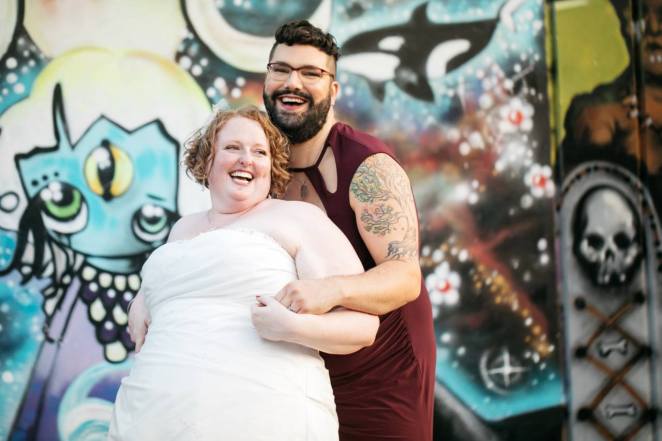
Then there are days like today where I look back at things like my wedding photos and I can put myself back in that moment. I think the times I can relate to my past self the most are times where I felt affirmed in my gender even if my presentation wasn’t what I wanted. My aggressively queer wedding was one of those moments. And my early childhood had a lot of those moments as well. It was after puberty started hitting and before I came into my own through my relationship with my spouse that are the hard times to look back on.

22550290_10155661448412332_8852752312265467863_o

Photo by Jenny GG Photography

Why you need to reject the idea of “passing” as cis

As I’m reading through some of the older articles by one of my favorite authors, Kai Cheng Thom, I came across this beauty:

How to Love Being a Non-Passing Trans Woman in 9 Affirming Steps

And I’m reminded how crucial accepting that fact was to my coming out journey.

There is so much pressure, both in the cisnormative world around us and from other trans people, to achieve some level of “passing” where people on the street or sometimes even people in the sheets can’t tell you are trans. For so many trans people, their ultimate goal is to get to a point where people think they are cisgender. And while there is a lot of power and safety in that and I absolutely do not blame people for wanting that, it is also a dangerous trap that can hold us back from truly being happy.

For so much of my life I thought that I couldn’t be trans because my body had grown in ways that I knew I could never reverse. With my broad shoulders, my strong chin, my large hands, my massive feet, and my deep bass singing voice, I knew that no matter how much surgery I had, I could never achieve my ideal of how I thought a woman should look. And I thought that meant that womanhood itself was hopelessly out of reach and at best I could just be a feminine man who was too attracted to women to be gay but too abnormal to be loveable. And it was largely because of that false belief that I allowed myself to settle for an abusive marriage.

For me at least, the path to self acceptance lay in embracing my femme identity with the full knowledge that I will never pass. I had to grieve the body I would never have and love the body I did have. I started out looking for the people who looked like I could when I started. Nonbinary icons who have never done medical transition and proudly display their beards and stubble like Alok Vaid Menon, Jacob Tobia, and Jeffrey Marsh. I surrounded myself with trans women so gorgeous that they take my breath away and I’ve slowly come to realize that I am that person for other people too. I leaned into the aspects of myself that I could make feminine for myself even if other people gendered them differently. I found joy in finding clothing that emphasized my tall frame and those rare gems that were size 13 heels.

I had to reject consciously and daily the idea that had to look traditionally feminine to be femme. Because femme at its core is a queer identity based in simultaneously embracing and queering feminine traits while rejecting many of the oppressive gender norms. My partners who are fiercely fat and femme helped me learn through this process how to hold yourself boldly even when you get glares in public for doing so. Of course I am not confident every day or even most of the time, but putting on that armor of femme identity helps push through those moments. I am femme despite society, not because of it. And finding my corner of weirdos and unconventional beauty helps me see the beauty in myself.

Once I had laid the groundwork in embracing my body and finding the parts of it that I love, only then could I truly identify what areas of my body needed change to fit MY dysphorias rather than what other people were projecting onto me. In many ways I truly loved my beard and how dramatic it made my face when paired with makeup and a dress. But I also could see how much happier I could be if I stopped avoiding my chin and made the necessary changes to bring it in line with who I want to be. And sometimes that means that things will get worse before they get better. But it is a lot easier to bear when I am doing these things for myself and not because I think I have to.

Another thing that has helped tremendously is realizing the incredible variety that exists within gender. For me, I like to look up to the cisgender women in my life like my mom who is 6 foot and my aunt who is 6’2″ and wears the same size shoes as me. And yes, sometimes they get accosted in restrooms about whether they belong but because they clearly do, it helps me know that I can too (not that I’ve actually worked up the courage for that yet). Women literally come in all shapes and sizes so don’t let someone tell you that you aren’t fully a woman because you look a certain way. They can shove off with their internalized misogyny.

Do I walk through the world confidently every day? Absolutely not. Do I love every aspect of my body? Hell no. Do I question the path I’ve taken? Sometimes. But I have earned my femininity just as much as someone who fits whatever this decade’s ideal of female beauty is. I am a nonbinary woman and I don’t need to pass.

What is dysphoria?

So I’ve talked quite a bit here about my experiences with dysphoria but I’m not sure I’ve ever attempted to define it, partly because it is a tricky concept to convey to someone who has never experienced it. But I’ll take a stab at it with the disclaimer that trans people don’t all experience dysphoria in the same way and some trans people never experience it because contrary to what psychologists think, being trans doesn’t require dysphoria. Some people are lucky enough to discover their true self through the experience of gender euphoria which is when you have extreme joy in finding something about your body, presentation, or the way people perceive you that affirms your gender.

On most days, I have a low level of background dysphoria going on. Some of it has always been there and I was kinda successfully ignoring it and some of it may not have been and has developed or been revealed as I’ve gotten closer to bring other parts in alignment with my gender. It’s hard to look back and accurately know what I was thinking in the past because one of my experiences of gender dysphoria is that my brain blocks out a lot of memories that don’t align with who I really am. A lot of my past is fuzzy or completely blocked from my consciousness due to trauma as well.

What I do know is that there were times that do clearly stick in my head where I experienced bursts of gender euphoria as a kid such as when I would play dress up and walk around in heels, or when I would play imaginary fairies or mermaids with my sister, or when I felt accepted as “one of the girls” in my friend groups. A lot of that went away as I reached an age where gender roles were more strictly enforced and in particular, a lot of my puberty is blocked from my memory both due to how I was treated by society and because more of my dysphoria started becoming apparent as the wrong hormone was taking front seat. I am so jealous of kids who have affirming parents and figure it out early enough to use hormone blockers or transition early on before the wrong puberty goes too far. It makes a lot of things easier.

One of the things I do know is that early on, stubble gave me dysphoria similar to how it does now. That, and my dysphoria around my prominent chin, are the biggest reasons I grew a beard at 18. I was getting to the point that I would have to shave my chin twice a day to look clean shaven. At first it was just a goatee but by 21 I think I was able to grow a full beard. A positive for combating dysphoria at the time but unfortunately now I have to get rid of all that thick, dense hair very painfully.

On a daily basis, dysphoria is like having little pin pricks constantly poking your skin. Or like wearing shoes that are too tight. It’s annoying and eventually it brings you to a breaking point. Everyone’s tolerance of that breaking point is why some people don’t come out until later while others figure it out early on. That can also be helped along by someone effectively helping you find the right size shoe and suddenly you realize how they didn’t fit all along. And trying to push past that background pain every day is exhausting and means that you can’t bring your full self to what you are doing until it is dealt with. I sometimes wonder where I would be in life if I had been born cis and been able to just move along happily through life without having to stop and deal with the dysphoria or the self worth issues that go along with it.

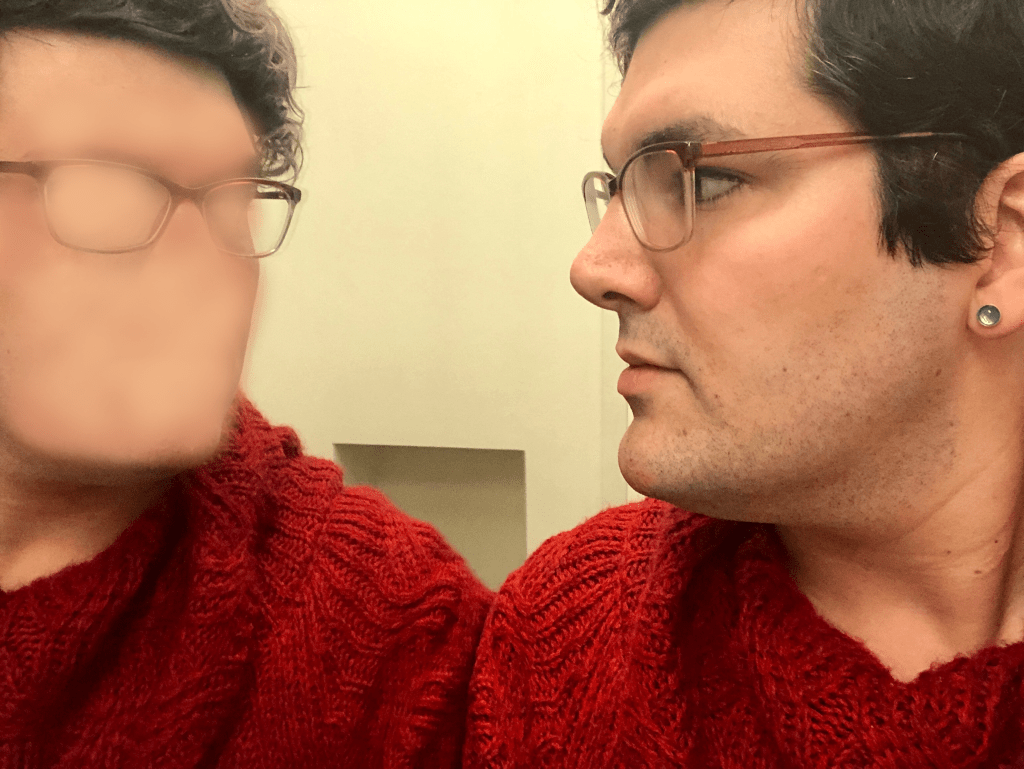
On days when my dysphoria is more acute, that pain is brought more to the forefront of my mind. Sometimes it is bad enough that I will look into a mirror and I can see enough to style my hair or assess my outfit but my face will be completely blurred out – as in I physically cannot get my brain to see my facial features. Dysphoria, as far as I can tell, is the brain not being able to handle the cognitive dissonance between the reality of your brain’s self image of you and what is physically in front of you. It also means that even on less bad days, parts of my body are often distorted so that what other people see isn’t the same as what I see. For me that most often revolves around my chin, or shoulders, or body hair. I will look at myself and all I can see is what feels to me like a giant, cartoonishly distorted chin with a cleft so big that I feel like Gaston from Beauty and the Beast.

Another way that dysphoria plays out for me, especially lately, is that an area of my body may feel completely absent. Most days now my genital area essentially feels like a black hole. It doesn’t exactly feel like there’s nothing there but almost the opposite of nothing like antimatter or something. That’s probably the biggest reason I’ve been much more asexual lately, at least with my own body. It is hard to think about sex when your mind is actively avoiding thinking about what body parts you might use. I’ve had to be much more creative and luckily when you have queer partners, using your own genitals isn’t as essential.

I’ve found that what helps the most when I’m feeling actively dysphoric is to focus on the parts of my body that I do like. Often it doesn’t help to have people compliment the areas you are feeling dysphoria around because it just brings more attention to them. But focusing on things like how great my legs are or how soft my skin is gets my mind to see the positives and less of the negatives. Sometimes affirmations can be helpful though, even if in the moment you can’t hear them. Lately I’ve been feeling more dysphoric around my speaking voice but when I’ve told people that, many have told me that it isn’t particularly deep and is actually rather feminine. Those are the things that I come back to later and think about when I’m struggling.

The reason that it is so essential to have insurance that covers gender affirming treatments and low barriers to accessing them is because dysphoria is such an insidious beast. It often feels like you can’t be a whole human until these parts of yourself are aligned with who you really are. And ultimately, all most of us really want is to be fully seen as ourselves. So please, don’t put up barriers to keep trans folks from getting there.

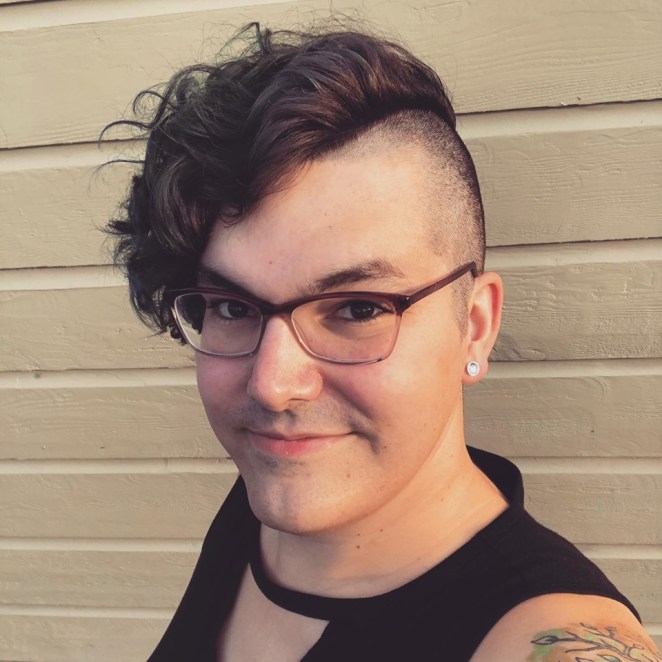
PS – I just remembered another trick I found to help combat dysphoria. Find things that you can do with your body to make it feel like your own that you can focus on when the rest of it feels wrong. For me it really helped me to be able to see myself to get my ears pierced, get fun glasses, get visible tattoos, and dye my hair. These things remind me that I can make changes because it is my body and my rules.
Metamorphosis

I’ve heard many trans people use the allegory of metamorphosis and seeing their transition phase as a cocoon but it really feels true. I am still struggling to figure out who I am without my beard now. The beard was a big part of who I was as a caterpillar and now that I don’t have it I am struggling to see the butterfly underneath the stubble. I can see my wings starting to form and I’m looking more and more like the idealized version of myself every day. But right now, especially between braces and electrolysis, I very much feel like I am in a cocoon phase. I really wish that I could just hide away until my metamorphosis is complete. But sadly I need a job and I’m an extrovert (though to a much lesser degree than before). Someday the butterfly will emerge even if not as dramatically as a single moment of unfurling my wings.

Brief thought of the day

I honestly thought I would have a beard my whole life because I couldn’t imagine a world where I was happy with my face. Other than the stubble which I’m working on, I think I’m getting there. I’m excited to see what it looks like after my jaw surgery.

Starting Electrolysis

I’ve passed the point of no return (queue Phantom of the Opera music). I’ve started electrolysis on my chin which means the beard is never coming back. I now have a quarter sized patch which is all inflamed at the moment where the hair has been permanently killed using a combination of electric current and heat to create a chemical reaction of lye to remove the whole follicle. And boy howdy was it painful!

I didn’t use a topical anesthetic this time and I definitely regret it. At first it wasn’t too bad. It was similar to tattoo needles but with the added weird sensation of radiating heat in your skin. But after a surprisingly short time, my body stopped ignoring the pain and by about 45 minutes I was begging for the hour to end. And the worst part was that it really wiped me out after. My body was just so exhausted that I came home and crashed.

Actually no, I take that back. The dysphoria caused by letting my stubble grow in for 5 days was the worst part. By this weekend I just felt gross and ugly in a visceral way. And when I added the pain to it on Sunday afternoon, it pushed me over the edge. All I could manage was getting high on pain relieving cannabis (legal here) and playing video games. Engaging my brain in Mass Effect Andromeda was the only way I kept from dissociating.

I feel much better today now that I’ve shaved. But it is odd to have a pink scabby spot on my chin that I’m acutely aware of. It is really going to take a long frickin’ time for that circle to grow to the size of my face. I’ve got a lot of sessions ahead of me but I’m glad that I found a trans esthetician to do it. I feel better about the sheer amount of money I’m going to be spending knowing I’m keeping it in the family. Hopefully next time with lidocane it will be better.

With the NYT article that is going around (which shows one valid point of view not representative of everyone), I think it is worth pointing out that the level of dysphoria I experience now is not something I expect to last forever. Starting my transition has made my dysphoria and mental health worse in some ways and better in others. It’s not a linear path but I do think that it is similar to facing any trauma – the only way out is through. The path to healing and authenticity is painful and dredges up a lot of feelings that have been buried. But that doesn’t mean it isn’t worth it or that it is a disease that I am looking for sympathy for. Treatment does help reduce dysphoria significantly but it’s a long game. You don’t get fast results.

What it does mean is that we need to reduce barriers to care for trans people. I so often hear the argument that things like hair removal shouldn’t be covered because then all the cis people should get it too. But that comes from a lens of equality rather than equity. Trans people have the most barriers to healthcare of pretty much anyone as a group. There are not only barriers from gatekeeping but the added burden of increased rates of employment and housing discrimination that keep many trans people in low paying jobs without coverage. Hair removal for many trans people is a crucial step needed to reduce gender dysphoria and if I didn’t have the money and life circumstances to be able to afford it out of pocket I wouldn’t have the ability to improve that distress.

So today I’m thankful for all the people who have supported my journey thus far. And for my job with decent medical benefits that allows me to start planning for bottom surgery (after I save enough for all the travel and associated out of pocket costs). And for my incredible partner and chosen family I live and share costs with that makes it possible to live near Seattle and still have money for things like electrolysis. I hope every person can find the kind of unconditional love that I have.