More thoughts on identity

I’m still struggling with knowing whether I am nonbinary because that’s who I truly want to be or as an artifact of the barriers I feel stand in the way of being a woman. I don’t necessarily feel like my brain is composed of part-masculine, part-feminine aspects. I very much feel like I was born with a girl’s brain in what was perceived as a male body. Most people these days understand that femininity is broad and can encompass tomboys and people who don’t wear makeup every day. And with the right body I think I would have made a great girl, although not one that could live up to the expectations of the cult I was raised in.

And I’m definitely a femme. I’m perfectly happy to put on jeans and a tshirt when I’m getting dirty or doing something outdoorsy. But I’ll always opt for very feminine clothing whenever it’s not extremely impractical. I’m not someone who puts on makeup every day but I certainly love doing it when I have the time and I am very particular about my appearance. In other words, a fairly typical woman in my appearance preferences.

So that just leaves my physical body. I’m tall and I have a large frame with wide shoulders and huge feet and hands. So I feel like I could never fit into culture as a woman which is mostly why I don’t try. It’s the fear of rejection from other women that keeps me stuck in this in-between place. Not that women can’t have that kind of frame either; my mom and my aunt certainly do although they often times get questioned in bathrooms about whether they belong because of it. They are 6 foot and 6′ 2″ respectively and my aunt has size 13 feet as well. So if they can do it, why can’t I?

As I’ve said a few times before, I keep my beard mainly because it covers up masculine features of my face that I really don’t like. Somehow the facial hair gives me less dysphoria than the underlying face. But I wonder if I also keep it as a signal to the rest of the world that I’m not trying to pass as a woman so they won’t judge me by that unattainable standard. I guess I’m scared of the ridicule trans women so often get so I try to avoid it by doing my own thing.

So then is nonbinary just a phase I’m passing through on the way to becoming a woman? It’s hard for me to say at this point. And just because it’s a phase doesn’t make it any less valid. It’s where I’m at right now and that’s all that really matters. I’ve found that no matter how much I try to plan, life seems to throw a wrench into the gears and redirect me. So I’m just going to take this one step at a time. I’m starting estrogen in 20 days and I’m curious to see what that does to my brain and my body to shape how I relate to them.

Who knows. One day I may need to rename this blog. But for now I remain your Bearded Genderqueer.
PS – I mostly maintain this blog as a way of shaping my own thoughts. When I start to have big gender feels I often come here to write about them before I’ve even fully thought them through. I wasn’t consciously aware of half the things I just wrote before I got there. So thanks for following along in my very confusing journey.

Gem Fusion

I don’t know how I’ve made it this long without gushing about Steven Universe! If you haven’t watched it yet you really should because it is THE best animated show on TV. It seems like a kids show at first but it has deep themes of queer representation, non-traditional families and gender roles, nonbinary characters, authentic relationship building skills, and self awareness.

As a nonbinary person I often feel like a gem fusion is the best way to describe what it is like to be me. Stevonnie, the nonbinary character who is a fusion of the titular Steven and his girlfriend Connie, is the most obvious analogy as it is a blend of their features, personalities, and genders meeting somewhere in the middle as a tall, attractive, dark haired androgyne.

But more often these days I find myself feeling like Garnet – a semi-permanent fusion between the volatile and aggressive Ruby and the prescient and peaceful Sapphire. They are both considered women but they represent very different ends of the gender presentation and behavior spectrum within femininity. Ruby wears pants and has a temper and personality that would typically be associated with masculinity. Sapphire wears a long dress, speaks softly, and is both kind and firm at the same time. Their relationship is a very obvious metaphor for queerness as the fusion of two different types of gems (as compared to two Rubies) is a taboo which results in them being shunned and hunted by the militaristic and colonizing Homeworld Gems.

While I could never aspire to be as cool and collected as Garnet herself, I really resonate with these two aspects of myself, the masculine and the feminine, blending together and co-existing in a single body while still being a woman. I’m much more of a lesbian than I want to admit, despite admiring some men physically, and the enduring romance between Ruby and Sapphire always gives me big feels. I hope that someday I can fully embody their values of flexibility, love, and trust in both myself and my relationships.

A Trans Woman in a Nonbinary Body

A year ago today I wrote a difficult post asking myself “am I really nonbinary?” This week I find myself asking similar questions as I’m preparing to start hormonal transition. And I think the conclusion that I’ve come to, at least for now, is that I’m essentially a trans woman in a nonbinary body.

I have felt for a very long time that there was a mix up in the womb and my brain went one way while my body went another. I should have been born a woman or at least I would have liked to figure out I was trans when I was young while there was still a chance of doing delayed puberty. But since I didn’t, I have a body that has gone through changes, some of which are irreversible. No amount of surgery is going to reduce my 6-foot-2 frame or make my hands or feet smaller. I could go through the whole process of vaginoplasty, facial feminization, hair removal, and tracheal shaves but for me it doesn’t feel worth it. Nothing I do will ever allow me to pass, and at this point I’m not sure that trying is going to accomplish anything.

I’ve learned to accept and even love a lot of things about the body I’m in. My beard has become a part of my identity and while I might hate my testicles, I’m pretty ok with my penis at this point. So instead of trying to reverse the last 30 years, my current strategy is to change the little things that make a difference like the amount of leg and chest hair, the size of my breasts, and my gender presentation through clothing. I’ve created my own mix of characteristics that reflect not only who I think I should have been but how the years have shaped me.

My strategy certainly wouldn’t work for everyone and I am not trying to criticize binary trans women in any way. But for me I suspect my dysphoria would be worse if I was close to passing as a woman but unable to gain that last 10%. Who knows how I’ll feel in 5 years or even after estrogen begins shaping my brain. But for now, my plan is to take hormones and if my brain responds well, to have an orchiectomy to remove my testes so I don’t have to take androgen blockers forever.

Gender is complicated and so are the ways in which we choose to cope. There’s no easy way to describe my gender but hopefully this gives you a little more insight into one path.

Trans Diversity

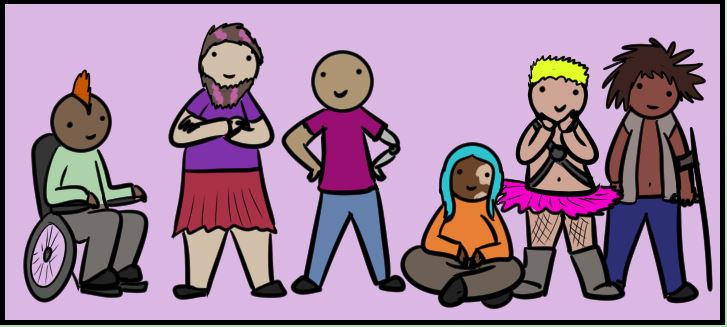
Trans and Nonbinary Diversity

Photo credit – Robot Hugs (c) 2017

I could wait until Trans Day of Visibility in March but since it’s on my mind now, I wanted to say a few things, mostly for the benefit of allies and friends who aren’t part of the trans and nonbinary communities.

Transgender people come in literally all shapes and sizes and colors. If you have a type of person that you picture when you think of us, I want to you make a conscious effort to broaden that.

Trans people have every kind of genital arrangement imaginable. Some people are born with genitals outside of the binary assumptions which we usually call intersex. And some intersex people identify as trans and some do not. Some people choose to have one or more of a wide variety of gender affirming surgeries to align their body with their identity, and for some people that isn’t even a choice but the difference between life and death. Some people consider themselves pre-op and are saving up for surgery or are trying to navigate a healthcare system that tries to exclude us. Some people are waiting for the out-of-the-box options they want to become available (like myself). Some people redefine their relationship with their genitals and may use different terms to refer to the parts they were born with. And some people don’t have any genital dysphoria.

Trans people don’t look a particular way. There are as many ways of performing and describing gender as there are people in the world. Some people want to be exclusively masculine or feminine and may describe as trans women or trans men. Some people want to blend in or “pass” while others prioritize feeling like themselves even if they don’t fit in. Some people are feminine but butch at the same time. Some people try to find a neutral place in the middle. Some people combine aspects of “traditional” gender binaries to create their own blend. Some people swing far in one direction and then settle on somewhere in the middle. And believe me when I say that someone’s appearance can’t tell you a damn thing about what they looked like when they were born.

Trans people come from every culture and race in the world. The idea that this is a new phenomenon is a very Western perspective. Gender diversity outside the binary has existed on nearly every continent for all of recorded history with an incredible variety of names and concepts. European and US colonization has attempted to wipe out many forms of gender presentation but we are resilient and many gender warriors have kept these traditions alive. And while the people that you know who are trans may be white, the people most at risk for violence are trans people of color who have led our movement from the beginning.

Trans people use an ever expanding vocabulary to describe ourselves and our experiences. There is no right or wrong way and for many of us, the evolution of language has literally been a lifesaver in helping us discover ourselves and the people like us. Some people use terms that others may find offensive. Some people change labels as their own understanding of themselves evolves. Some people categorize words differently such as including their nonbinary identity under the trans label while other nonbinary people don’t feel like they fit in yet another binary of cisgender vs transgender. Some people feel like they don’t have any gender while some people feel like they have a lot. The only way you will know how someone describes themselves is if you respectfully ask.

Trans people use more pronouns than you’ve probably even thought of. Some people choose binary labels even if they don’t identify that way. Many people use they/them/theirs as a gender neutral pronoun, reclaiming ways in which it was used in historic English and continues to be used despite grammar police. Some people use different pronouns depending on how they are feeling or presenting that day. Some people create new terms like xe/xem/xyrs and ze/hir/hirs. If you want help learning how to use it in a sentence, just ask, or better yet, look it up.

Trans people have every intersection of ability and mental health imaginable. Because of the pressures and discrimination we have faced, many of us have the added burden of chronic health and mental illness. Nearly half of us have depression and/or anxiety. Over 40% have attempted suicide. And for reasons I don’t think are fully understood, there is a huge overlap between gender nonconformity and autism. When trans people get together we will often talk about these challenges openly even if we may be reluctant to share that with you because of how our identity was so recently treated like a mental illness itself. But just because someone is trans doesn’t mean you should assume they face these issues either.

Even here I’ve probably said some things that overgeneralize or erase experiences. I apologize for leaving things out but the main point I want you to take away is that you should never make assumptions. Even if you think you’ve never met a trans person, it’s very likely that you just didn’t know it. So rather than finding new ways to exclude us, think about all the ways your community and life could be enriched by the diversity of experiences we bring to the table.

#TransIsBeautiful

#TransResilience

An open letter to OKCupid about the proposed “Real Name” policy

Here is a copy of what I wrote in the OKCupid feedback form in response to their proposed policy change that would require real first names instead of custom usernames by the end of 2017.

Dear OKC team,
I’ve been a user since 2004, I met my spouse here, and I’ve had many relationships ranging from casual to long term that started on your site. I love a lot about your site and I am usually a fan of your changes, especially those to reduce unwanted and harassing messages. I’m not the type to complain every time someone releases a new feature, even if I’m not a fan.

However, I sincerely hope that by “real name policy” you don’t mean to police that like Facebook has done to the detriment and harm of transgender people. For many people, the name that everyone knows them by is not the name on their government issued ID. And forcing someone to use a real name not only violates their privacy but can cause extreme emotional harm and potential violence towards them. It has driven many trans people off of Facebook and I truly hope that you won’t undo the great work you put in with your expanded gender options by forcing us to use our “birth names” which many of us call our dead names.

As a nonmonogamous person, I also know that many people are not “out” about their identity to family and coworkers because we have no workplace protections or laws to protect us from societal harm. Almost every polyamorous person I know is on OKC but a LOT of them will be leaving soon if you enforce this rule.

Then there’s the safety concern in general, especially for women, who are opening themselves up to stalkers by having a profile with their real name. Being on OKC and revealing the kinds of personal details we do already contains a huge amount of risk, especially for queer, feminine, transgender, nonbinary, nonmonogamous people like me. And having that data attached to our real name is not only going to drive a large portion of your loyal users away, but it will likely cause a lot of those who stay to be more cautious about what they share, harming their potential for building successful relationships.

People have a lot of options for dating sites these days and most of us are here because right now you are the best, particularly around nonmonogamy, gender, and sexuality. Please don’t ruin a good thing by forcing real names.


If you are an OKCupid user and you have opinions about the change, please take a moment to speak up on Twitter, use their feedback form, or comment on their blog post.

Update: They seem to have clarified on their Twitter:

We love our members. You do not need to use your government name or even your full first name. Use the name, nickname, or initials you’d like your date to call you on OkCupid.

What do you love about yourself?

What are the parts of yourself that you love? The things you can appreciate without a long list of qualifiers.

I love my long, muscular legs with my thick, powerful thighs and my shapely calves. I like them better when they don’t have hair but regardless I love that they take me wherever I want to walk and they have never broken, no matter how hard I have taxed them.

I love my cute butt with its little dimples.

I love that my brain has a natural inclination to organize data and objects. I can get into the nitty gritty details and still see the whole picture. And even if the jobs don’t necessarily pay that well, it does get me decent job opportunities. And helps keep my house and my digital life in order.

I love my fingernails with their nice, deep nail beds that look great with polish.

I love my arms which have somehow managed to maintain some muscular definition despite years of not working out intentionally. And I especially love my left arm with my big tree of seasons tattoo.

I love my beard that grows in nice and thick and curls so tightly that it covers any imperfections in my face.

I love my empathetic heart which helps me draw closer to the people in my life and gives me motivation to make the world around me a better place.

What do you love about yourself? So often our minds choose to focus on the parts we don’t like, especially when those give us uncomfortable feelings like dysphoria. So take a moment today to appreciate your body, your brain, and your heart and maybe share a little something in the comments.

Transgender Big Siblings

More and more I’m getting requests from friends and acquaintances for resources for their own friends who have trans or nonbinary kids or for youth who need role models to see what it could look like to be a trans adult. And while I’ve added some info I found on gender identity in young children to my resources section, I’m starting to think that maybe what we need now is a Transgender Big Siblings program that would pair trans adults with families where the parents are trying to be supportive but need more than online resources.

The idea literally just came to me as I was reading yet another article that talked about a parent who has a trans daughter and is trying to follow her lead but fears for her future. And yes, the future isn’t as easy for a lot of us trans folk, but it is getting better all the time and it would probably be incredibly relieving for someone like her to talk to someone like me who has supportive partners and a job where I can be out.

Does anyone know if such a thing already exists or if there are other people trying to start this?

AMAB Terminology

So as you may have noticed, I refer to myself frequently on this blog as AMAB which means Assigned Male At Birth. So I want to elaborate on what that means to me (aka, not an expert) and why it’s not a good idea to assume that someone else is OK with that descriptor.

The language to describe transgender and nonbinary experiences and identities has evolved A LOT recently. For example, unless someone self identifies as transsexual, it’s not social acceptable anymore to call someone that. There are definitely people who still use the term for a variety of personal and historical reasons such as Julia Serano. But similar to how many other marginalized communities have either rejected or reclaimed words, the trans community is currently in a linguistic revolution.

Which brings me to my point. For a while recently there seemed to be general consensus that the terms AMAB or DMAB (Designated Male At Birth) were the best terms to use to describe people born with a penis who no longer identify as cisgender men in relevant contexts. But part of why that term was used is because it refers to how society, medical staff, and often our families, chose to gender us against our will. Another term that was used similarly was CAMAB (Coercively Assigned Male At Birth) to indicate the non-consensual nature of it. The term MAAB (Male Assigned at Birth) was also used but mostly by TERFs (Trans Exclusionary “Radical Feminists”) in my experience.

But these days, many kids are lucky enough to not have to go through as much of the denial of their gender. Kids are smart and a lot of people know as early as 2-5 that they like thinks such as dresses and dolls or other rejections of masculinity. And more and more, progressive parents and communities are supporting that and either raising their kids as gender neutrally as possible or looking for the signs the kid is displaying and supporting their identity and social “transition” (if you can even call it such at that age). We also now have much better healthcare options such as gender clinics at Children’s Hospitals which allow kids to medically transition younger or use hormone blockers to prevent or delay puberty.

As a result, not all kids are assigned a gender in the same way that those of us who transitioned as adults were. They probably get assigned a letter on their birth certificate but they don’t always have to fight for their identity against constant coercion to be masculine. So I don’t think it is right anymore to simply call someone AMAB because of your assumption about the body parts or chromosomes they had at birth.

As some of my friends have pointed out, when cisgender people use AMAB terminology in conversation, it can often be a politically correct way of misgendering someone or even outing them non-consensually. Whether someone “passes” or not, it isn’t really a stranger’s business what they got assigned in the hospital and definitely not what body parts or assumed chromosomes they have. Don’t try to earn yourself ally cookies by using our identity to brag about your acceptance. For example, unless that person has said it is OK, don’t say things like “my AMAB daughter” or “my AMAB partner.” It often feels like we are being treated as less than real when those terms are used. Saying that a trans woman “was something else” by referring to her dead name or assigned gender is incredibly hurtful and offensive and is far too often used as a weapon against us by TERFs and other bigots.

The reason I use the term here in my blog is because I personally do claim the term AMAB as an important part of my identity. My path to discovering myself is long and complicated but I do think it is useful in understanding ME to know that I thought I was just a weird boy for a long time. I know that if my parents ever described me as their AMAB kid it would feel very affirming because it means that they understand me and have adopted my chosen language as well as my current frame of reference. I very much was assigned male in every sense of the word and it shaped me (though not always in the ways you think), especially in a very unique part of my gender presentation – my beard.

I know I have probably used the term AMAB too broadly when referring to my slice of community here. But I’m not going to go back and edit those right now because the reason for me starting this blog still stands. I want to create online representation for people like me who have beards and who were assigned masculinity and have adopted femininity instead.

So please, keep referring to me as AMAB. But practice removing it from your assumptions about other people.

Gender euphoria

The flipside to the gender dysphoria I often talk about is that sometimes when I’m feeling really good about my body and identity I experience the glow of gender euphoria.  Today is one of those days I feel sexy AF! I’m loving the outfit I’m wearing and how it emphasizes my gorgeous legs. My shirt makes it look like I have great breasts and it shows just enough chest to make me feel good. And I’m wearing the shoes that never fail to get compliments. Some days it feels great to be me.

2017-08-08 08.11.562017-08-08 08.21.14

Dysphoria again

Fucking dysphoria! Just when I think my day is going to be great, I glance in the mirror and see this ugly fat guy wearing unflattering clothes with huge shoulders. If I wasn’t already at work I would rip my clothes off and start over but it’s too late for that now.