How clothing revealed my gender

I started estrogen yesterday! Besides feeling a little fuzzy, no changes yet but I’m really enjoying the symbology of my rebirth being on the first day of Spring.

As I’m beginning a kind of transition that people seem to be taking more seriously, I am thinking about some of the ways that “I knew” I was transfeminine. And one of the biggest ones as an adult was clothing.

I have never been that comfortable in masculine clothing. I mean I’m perfectly fine wearing jeans and a t-shirt for doing dirty work or walking the dogs. But the more formal I had to dress, the more uncomfortable and out of place I felt. It felt like I was putting on clothing that didn’t belong to me and didn’t fit my body.

For years I experimented with options to see what felt comfortable. As a kid I didn’t really think about it too much because when I was allowed to choose, I wore the jeans and t-shirt uniform. Or something practical like cargo pants when I went hiking so I could store my camera lenses. I never felt like anything looked good on me so I went for utility instead. And it was hard to disentangle my discomfort with more formal clothing from the discomfort around the situations I had to wear them in such as fundamentalist churches and cult conferences. Although I did know that wearing ties made me feel like I was being strangled, and not just in the physical sense.

Once I started having office jobs where I had to wear collared shirts, I bounced around between styles for awhile trying to find something that worked. I eventually found I felt best wearing purple so I settled on a lot of that for awhile during my “preppy” phase. But it still didn’t feel natural. I also got really bored with how few options there were for masculine clothing without accessories so I found myself collecting more and more different outfits and shades of drab pants in order to mix things up as much as socially acceptable. Everyone already thought I was gay so I was afraid of getting too adventurous about bright colors at that point.

As I got farther away from fundamentalism and more involved in LGBTQ rights as what I called a “gender nonconforming ally” at that point, I lost some of that fear of being perceived as gay. I was in a straight monogamous marriage with a woman at that point so I guess I felt that people would stop questioning me. Though as I adopted more inclusive language like calling my spouse with her gender neutral name “partner,” it didn’t do much to allay the rumors at work.

I did eventually start wearing more and more bold colors. I got brightly colored pants and fun patterned shirts that ended up being read as pretty gay. And that was the closest I came to feeling comfortable in masculine clothing. I also enjoyed the increased compliments on my appearance I got as people started reading me as more gay. Part of that was definitely the quality of the outfits I was putting together but some of it was probably due to working in women dominated fields and dressing in ways that made it more socially acceptable to comment on clothing.

Then, as I got more involved in polyamorous community and started dating other queer people, I began to realize that there was more to my identity than I was allowing myself to consider. And as I began to see myself as genderqueer, I experimented with more androgynous outfits at work. The problem is that for someone whose body is read as male to look androgynous, it is hard to dress formal. So much of what we perceive as androgyny is white, thin, AFAB (assigned female at birth) people dressing dapper or masculine of center. So on days I wanted to dress androgynous I had to dress down. And whether it was because of that or because of the change in gender expression, I realized I was getting less compliments at work and it felt like people were less likely to talk to me in general the less I fit the binary.

So I stopped pushing the boundaries as much at work. But once I escaped my marriage with a person who was ostensibly fine with queer people around her but not with any expressions of queerness or transness in her spouse, I started dressing more femme at home. It took me a long time to find things that fit me and looked good on my body (and that I could afford) but I slowly began building a wardrobe of clothing that felt much more gender affirming. And the more I wore dresses and cowl neck sweaters and tight pants, the more comfortable I felt.

In the moments when I was dressing femme it felt like I had shed the exoskeleton that was too tight and constricting my body. It felt freeing not just in an emotional sense but in a very tangible physical release as well. And that’s when I knew I was making the right choice and that I could never go back.

Because of a terrible new boss, I had to switch jobs right around the time that it was getting pretty hard to keep dressing masculine. And based on the advice of some other trans women, I interviewed in clothing that was as masculine as I could stand at that point. Which pretty much meant my gayest outfits. It took 6 months but I finally found a job and on my last day at the old job I wore a dress to say goodbye.

On the first day of my new job I outed myself to my new team as nonbinary and was amazed at how quickly they started using my pronouns. But I kept dressing as masculine as I could tolerate while I settled in. After 7 weeks I finally got the courage to talk to my supervisor about clothing and started dressing in the more androgynous outfits again while I worked on building up a wardrobe of professional femme clothing. There was some initial shock as they realized just how trans I was but it quickly faded into normal for them and now I only get compliments at work.

So the moral of the story is, if you never feel comfortable in the options you are “allowed” to wear, there might be something under that you need to explore. I am in love with femme clothing and I am so glad I have a place where I am affirmed in that expression at home and at work.

On relationships

I just want to say how incredibly thankful I am for my spouse/anchor partner and the chosen family I’ve built. I cannot emphasize enough how helpful it is, especially during transition, to have people in your life who love you both for who you are and for how you change. Because change is inevitable no matter what your circumstances. As Octavia Butler says in her Earthseed series:

“All that you touch You Change.

All that you Change Changes you.

The only lasting truth is Change.”

I’ve had too many relationships in my life, both romantic and platonic, where I was expected to remain the way they saw me when we first met. Where their idea of who I am was more important than actually getting to know who I am. I spent 7 years in a relationship with my ex-wife where I was denigrated for becoming who I truly am. And life is too short for that. As far as I know we only get one shot at this and I’m not going to spend it pretending to be what someone else wants me to be.

It’s not an easy path to leave those people behind and venture into the unknown but because I’m living my truth, I have found people who love me for it. The hardest thing to find is the people who can honestly face change and love you through it and for it. Sometimes change means that relationship structures need to change as well. But that doesn’t necessarily mean that you need to lose that person. I’m particularly grateful to my platonic long-term partner who not only has remained part of my family after we stopped dating but lives with me and supports me daily.

For all of you in unhealthy relationships or who are despairing of ever finding people who can love you like that I just want to say that you are unique and special and deserving of love. And I promise that there are people out there who can love you for who you are. I despaired for so long because I was convinced that I could never be lovable for the aspects of myself I feared or hated. But life has proved that belief wrong many times over. So don’t get desperate and compromise your values or self-worth. Keep living your truth and becoming the best self you can be.

More thoughts on identity

I’m still struggling with knowing whether I am nonbinary because that’s who I truly want to be or as an artifact of the barriers I feel stand in the way of being a woman. I don’t necessarily feel like my brain is composed of part-masculine, part-feminine aspects. I very much feel like I was born with a girl’s brain in what was perceived as a male body. Most people these days understand that femininity is broad and can encompass tomboys and people who don’t wear makeup every day. And with the right body I think I would have made a great girl, although not one that could live up to the expectations of the cult I was raised in.

And I’m definitely a femme. I’m perfectly happy to put on jeans and a tshirt when I’m getting dirty or doing something outdoorsy. But I’ll always opt for very feminine clothing whenever it’s not extremely impractical. I’m not someone who puts on makeup every day but I certainly love doing it when I have the time and I am very particular about my appearance. In other words, a fairly typical woman in my appearance preferences.

So that just leaves my physical body. I’m tall and I have a large frame with wide shoulders and huge feet and hands. So I feel like I could never fit into culture as a woman which is mostly why I don’t try. It’s the fear of rejection from other women that keeps me stuck in this in-between place. Not that women can’t have that kind of frame either; my mom and my aunt certainly do although they often times get questioned in bathrooms about whether they belong because of it. They are 6 foot and 6′ 2″ respectively and my aunt has size 13 feet as well. So if they can do it, why can’t I?

As I’ve said a few times before, I keep my beard mainly because it covers up masculine features of my face that I really don’t like. Somehow the facial hair gives me less dysphoria than the underlying face. But I wonder if I also keep it as a signal to the rest of the world that I’m not trying to pass as a woman so they won’t judge me by that unattainable standard. I guess I’m scared of the ridicule trans women so often get so I try to avoid it by doing my own thing.

So then is nonbinary just a phase I’m passing through on the way to becoming a woman? It’s hard for me to say at this point. And just because it’s a phase doesn’t make it any less valid. It’s where I’m at right now and that’s all that really matters. I’ve found that no matter how much I try to plan, life seems to throw a wrench into the gears and redirect me. So I’m just going to take this one step at a time. I’m starting estrogen in 20 days and I’m curious to see what that does to my brain and my body to shape how I relate to them.

Who knows. One day I may need to rename this blog. But for now I remain your Bearded Genderqueer.
PS – I mostly maintain this blog as a way of shaping my own thoughts. When I start to have big gender feels I often come here to write about them before I’ve even fully thought them through. I wasn’t consciously aware of half the things I just wrote before I got there. So thanks for following along in my very confusing journey.

To be or to love

My deepest truth is that I have never been able to disentangle my desire to be with women from my desire to be a woman.

I have always been most comfortable in the company of women and had a hard time connecting to masculinity. The only men I have been able to get close to are the ones who are more effeminate in their interests and presentation as well. As a kid and as an adult I frequently find myself being the only non-woman in a classroom or workplace, especially since I work in a career path that is 95% women. And now, as I prepare to take feminizing hormones, I find myself having to come to grips with that fact once more.

For the past few years I have entertained the fantasy that I am queer enough to date across the full gender spectrum. But if I’m being honest with myself I can look back and realize that beyond the trends of convenience there is the sad fact that I just don’t connect as deeply with masculine people. As much as I love my transmasculine siblings, I don’t have the same chemistry with them as I do with femmes. And I always feel terribly awkward around cis men and out of place in gay male culture.

I’ve frequently joked about being a lesbian to cover up the fact that I desperately wish I could truly be considered one. And when I think about transition, this is really the biggest thing that draws me to doing a more binary route. My femininity has always been about how I relate and want to relate to women, not about my relationship to men. Which I think is why I’ve always been drawn to feminist circles even when that was highly taboo for my culture.

As terrible as the world is around us, the part that saddens me the most is the bigots within our own movement who seek to exclude people like me – the TERFs (Trans Exclusionary “Radical Feminists”). I can kinda understand why the world at large has a hard time wrapping its head around me and how I defy categories. But for a group of people who spend so much time thinking about gender and the constructs surrounding it to pretend like it is so impermeable that I can never cross that threshold really does hold me back. I desperately want to be included in everything as “one of the girls” but I know that no matter how hard I fight, I can never pass enough to do so.

I am so grateful for my friends who have made conscious efforts at inclusivity. I recently was invited to a gaming group that a friend expanded to include women and femmes. And every time someone lumps me in with a group that is primarily women I get warm fuzzy feelings. Does this mean that I am a trans woman and genderqueer is just a waypoint on my journey? I honestly don’t know.

What I do know is that I can only take it one step at a time. I am excited to start estrogen and see what effect that has on my brain and my body. A lot of the things people talk about experiencing are already commonplace for me like the readily accessible emotions, the frequent crying, and the mood cycles. So if I am already like this without hormones, what will that look like? Who knows. Maybe I will eventually become the lesbian I’ve always dreamed of being.

Gem Fusion

I don’t know how I’ve made it this long without gushing about Steven Universe! If you haven’t watched it yet you really should because it is THE best animated show on TV. It seems like a kids show at first but it has deep themes of queer representation, non-traditional families and gender roles, nonbinary characters, authentic relationship building skills, and self awareness.

As a nonbinary person I often feel like a gem fusion is the best way to describe what it is like to be me. Stevonnie, the nonbinary character who is a fusion of the titular Steven and his girlfriend Connie, is the most obvious analogy as it is a blend of their features, personalities, and genders meeting somewhere in the middle as a tall, attractive, dark haired androgyne.

But more often these days I find myself feeling like Garnet – a semi-permanent fusion between the volatile and aggressive Ruby and the prescient and peaceful Sapphire. They are both considered women but they represent very different ends of the gender presentation and behavior spectrum within femininity. Ruby wears pants and has a temper and personality that would typically be associated with masculinity. Sapphire wears a long dress, speaks softly, and is both kind and firm at the same time. Their relationship is a very obvious metaphor for queerness as the fusion of two different types of gems (as compared to two Rubies) is a taboo which results in them being shunned and hunted by the militaristic and colonizing Homeworld Gems.

While I could never aspire to be as cool and collected as Garnet herself, I really resonate with these two aspects of myself, the masculine and the feminine, blending together and co-existing in a single body while still being a woman. I’m much more of a lesbian than I want to admit, despite admiring some men physically, and the enduring romance between Ruby and Sapphire always gives me big feels. I hope that someday I can fully embody their values of flexibility, love, and trust in both myself and my relationships.

Societal Expectations

So much of my brain energy, especially lately, is consumed with thinking about what I really want because I want it and what is just because society expects something. For example last month I went back and forth quite a bit, as I often do, on whether I should grow my hair out to look more feminine or keep my curlyqueer cut with the close buzzed sides and long top. I ended up going short again because I know how to manage my curls that way, it takes less time, and I feel like myself that way. But I still question whether I would like myself with longer hair if I could get through the grow-out process or if I just think I need that so I am less likely to be read as male.

Do most people think about societal expectations this much? Or just feminists? Or just trans people? I don’t even know what is “normal” anymore.

A Trans Woman in a Nonbinary Body

A year ago today I wrote a difficult post asking myself “am I really nonbinary?” This week I find myself asking similar questions as I’m preparing to start hormonal transition. And I think the conclusion that I’ve come to, at least for now, is that I’m essentially a trans woman in a nonbinary body.

I have felt for a very long time that there was a mix up in the womb and my brain went one way while my body went another. I should have been born a woman or at least I would have liked to figure out I was trans when I was young while there was still a chance of doing delayed puberty. But since I didn’t, I have a body that has gone through changes, some of which are irreversible. No amount of surgery is going to reduce my 6-foot-2 frame or make my hands or feet smaller. I could go through the whole process of vaginoplasty, facial feminization, hair removal, and tracheal shaves but for me it doesn’t feel worth it. Nothing I do will ever allow me to pass, and at this point I’m not sure that trying is going to accomplish anything.

I’ve learned to accept and even love a lot of things about the body I’m in. My beard has become a part of my identity and while I might hate my testicles, I’m pretty ok with my penis at this point. So instead of trying to reverse the last 30 years, my current strategy is to change the little things that make a difference like the amount of leg and chest hair, the size of my breasts, and my gender presentation through clothing. I’ve created my own mix of characteristics that reflect not only who I think I should have been but how the years have shaped me.

My strategy certainly wouldn’t work for everyone and I am not trying to criticize binary trans women in any way. But for me I suspect my dysphoria would be worse if I was close to passing as a woman but unable to gain that last 10%. Who knows how I’ll feel in 5 years or even after estrogen begins shaping my brain. But for now, my plan is to take hormones and if my brain responds well, to have an orchiectomy to remove my testes so I don’t have to take androgen blockers forever.

Gender is complicated and so are the ways in which we choose to cope. There’s no easy way to describe my gender but hopefully this gives you a little more insight into one path.

Fertility and Hormones

The thing that I’ve had on my mind a lot lately is the question of when to begin my hormonal transition in relation to what to do about having a child. I’ve known I wanted a baby since I was pretty young, though in more of a maternal parenting role than a paternal one. The only times I’ve questioned that were when the pressures to be a father made me feel inadequate to the task. And especially since learning that induced lactation is possible, I’ve known that starting from infancy is definitely what I want to do.

But the thing is, I’m not in a place yet where I’m ready to start a family. Part of that is personal – I think I need to do more growth and self work before I am ready to devote that much time and attention on a mini human. And part of that is situational – my spouse doesn’t want to be a primary parent and I don’t have anyone else to co-parent with in my life right now.

The part that gives me pause is what to do about my sperm. Once I start hormones it is fairly likely that I will quickly become permanently infertile. There aren’t a lot of studies  about what happens when you stop hormones but the advice is to assume that it is a permanent change. I’ve looked into freezing my sperm but that is a very expensive procedure with no guarantee of success, and frankly, I don’t have the money right now dues to other high medical expenses. It also requires me to have good sperm count and motility to begin with and I’m becoming less and less sure that is the case. When my hormone levels were checked recently, my testosterone was low (no surprise) which doesn’t bode well. I also have many habits that tend to lower fertility such as wearing tight clothing, smoking pot, and taking ibuprofen.

So even if I was ready to make a baby right now, there is no guarantee I could do it without major changes that don’t really seem possible. I don’t want to take testosterone supplements because that’s the opposite of what I’m trying to do. It would be very difficult to wear loose clothing with my current style and wardrobe. And cannabis is the only thing I’ve found that makes my chronic pain even tolerable.

As I’ve come to accept that, I’ve realized that I can’t keep waiting on starting my transition. It’s harming my mental health to be stuck in this limbo waiting for a sign. So I’ve setup an appointment with my primary care physician, who luckily specializes in trans patients, to talk about starting hormones. I am going to have to trust that if the universe wants me to have a child, destiny is going to have to meet me halfway.

There are other options for the future. Being nonbinary and nonmonogamous with a nontraditional family structure means that adoption would be difficult, especially through an agency, but there are local places friends have recommended where the birth parent gets to make a choice. What I’m really hoping happens is that I find someone to co-parent with who has a working uterus and possibly another partner with sperm. If not there is always artificial insemination or surrogate parents.

Right now I need to focus on beginning my transition and hopefully along the way find the right way to build a family. If anyone is interested in starting conversations about co-parenting, platonically or otherwise, please let me know.

Trans Diversity

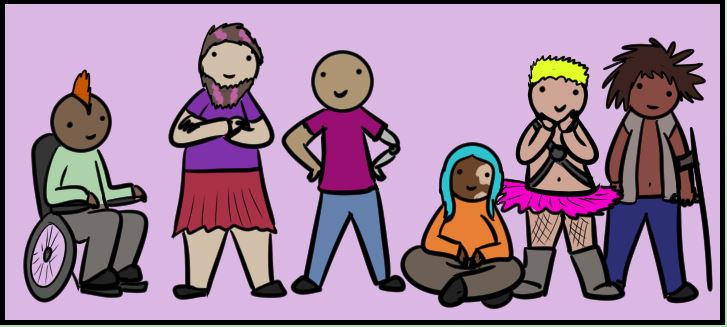
Trans and Nonbinary Diversity

Photo credit – Robot Hugs (c) 2017

I could wait until Trans Day of Visibility in March but since it’s on my mind now, I wanted to say a few things, mostly for the benefit of allies and friends who aren’t part of the trans and nonbinary communities.

Transgender people come in literally all shapes and sizes and colors. If you have a type of person that you picture when you think of us, I want to you make a conscious effort to broaden that.

Trans people have every kind of genital arrangement imaginable. Some people are born with genitals outside of the binary assumptions which we usually call intersex. And some intersex people identify as trans and some do not. Some people choose to have one or more of a wide variety of gender affirming surgeries to align their body with their identity, and for some people that isn’t even a choice but the difference between life and death. Some people consider themselves pre-op and are saving up for surgery or are trying to navigate a healthcare system that tries to exclude us. Some people are waiting for the out-of-the-box options they want to become available (like myself). Some people redefine their relationship with their genitals and may use different terms to refer to the parts they were born with. And some people don’t have any genital dysphoria.

Trans people don’t look a particular way. There are as many ways of performing and describing gender as there are people in the world. Some people want to be exclusively masculine or feminine and may describe as trans women or trans men. Some people want to blend in or “pass” while others prioritize feeling like themselves even if they don’t fit in. Some people are feminine but butch at the same time. Some people try to find a neutral place in the middle. Some people combine aspects of “traditional” gender binaries to create their own blend. Some people swing far in one direction and then settle on somewhere in the middle. And believe me when I say that someone’s appearance can’t tell you a damn thing about what they looked like when they were born.

Trans people come from every culture and race in the world. The idea that this is a new phenomenon is a very Western perspective. Gender diversity outside the binary has existed on nearly every continent for all of recorded history with an incredible variety of names and concepts. European and US colonization has attempted to wipe out many forms of gender presentation but we are resilient and many gender warriors have kept these traditions alive. And while the people that you know who are trans may be white, the people most at risk for violence are trans people of color who have led our movement from the beginning.

Trans people use an ever expanding vocabulary to describe ourselves and our experiences. There is no right or wrong way and for many of us, the evolution of language has literally been a lifesaver in helping us discover ourselves and the people like us. Some people use terms that others may find offensive. Some people change labels as their own understanding of themselves evolves. Some people categorize words differently such as including their nonbinary identity under the trans label while other nonbinary people don’t feel like they fit in yet another binary of cisgender vs transgender. Some people feel like they don’t have any gender while some people feel like they have a lot. The only way you will know how someone describes themselves is if you respectfully ask.

Trans people use more pronouns than you’ve probably even thought of. Some people choose binary labels even if they don’t identify that way. Many people use they/them/theirs as a gender neutral pronoun, reclaiming ways in which it was used in historic English and continues to be used despite grammar police. Some people use different pronouns depending on how they are feeling or presenting that day. Some people create new terms like xe/xem/xyrs and ze/hir/hirs. If you want help learning how to use it in a sentence, just ask, or better yet, look it up.

Trans people have every intersection of ability and mental health imaginable. Because of the pressures and discrimination we have faced, many of us have the added burden of chronic health and mental illness. Nearly half of us have depression and/or anxiety. Over 40% have attempted suicide. And for reasons I don’t think are fully understood, there is a huge overlap between gender nonconformity and autism. When trans people get together we will often talk about these challenges openly even if we may be reluctant to share that with you because of how our identity was so recently treated like a mental illness itself. But just because someone is trans doesn’t mean you should assume they face these issues either.

Even here I’ve probably said some things that overgeneralize or erase experiences. I apologize for leaving things out but the main point I want you to take away is that you should never make assumptions. Even if you think you’ve never met a trans person, it’s very likely that you just didn’t know it. So rather than finding new ways to exclude us, think about all the ways your community and life could be enriched by the diversity of experiences we bring to the table.

#TransIsBeautiful

#TransResilience

An open letter to OKCupid about the proposed “Real Name” policy

Here is a copy of what I wrote in the OKCupid feedback form in response to their proposed policy change that would require real first names instead of custom usernames by the end of 2017.

Dear OKC team,
I’ve been a user since 2004, I met my spouse here, and I’ve had many relationships ranging from casual to long term that started on your site. I love a lot about your site and I am usually a fan of your changes, especially those to reduce unwanted and harassing messages. I’m not the type to complain every time someone releases a new feature, even if I’m not a fan.

However, I sincerely hope that by “real name policy” you don’t mean to police that like Facebook has done to the detriment and harm of transgender people. For many people, the name that everyone knows them by is not the name on their government issued ID. And forcing someone to use a real name not only violates their privacy but can cause extreme emotional harm and potential violence towards them. It has driven many trans people off of Facebook and I truly hope that you won’t undo the great work you put in with your expanded gender options by forcing us to use our “birth names” which many of us call our dead names.

As a nonmonogamous person, I also know that many people are not “out” about their identity to family and coworkers because we have no workplace protections or laws to protect us from societal harm. Almost every polyamorous person I know is on OKC but a LOT of them will be leaving soon if you enforce this rule.

Then there’s the safety concern in general, especially for women, who are opening themselves up to stalkers by having a profile with their real name. Being on OKC and revealing the kinds of personal details we do already contains a huge amount of risk, especially for queer, feminine, transgender, nonbinary, nonmonogamous people like me. And having that data attached to our real name is not only going to drive a large portion of your loyal users away, but it will likely cause a lot of those who stay to be more cautious about what they share, harming their potential for building successful relationships.

People have a lot of options for dating sites these days and most of us are here because right now you are the best, particularly around nonmonogamy, gender, and sexuality. Please don’t ruin a good thing by forcing real names.


If you are an OKCupid user and you have opinions about the change, please take a moment to speak up on Twitter, use their feedback form, or comment on their blog post.

Update: They seem to have clarified on their Twitter:

We love our members. You do not need to use your government name or even your full first name. Use the name, nickname, or initials you’d like your date to call you on OkCupid.